Article Directory
A camshaft is the mechanical timing brain of an internal combustion engine. One precision-machined shaft with egg-shaped lobes decides exactly when every intake and exhaust valve opens and closes, and that decision happens in milliseconds. At 6,000 rpm, each valve opens 50 times per second; a two-degree error in lobe phasing cuts peak power by roughly 5-8 percent while raising fuel consumption. The choice of camshaft material, lobe profile, and manufacturing tolerance can be the difference between an engine that runs quietly for 200,000 miles and one that fails at 30,000.
The camshaft converts crankshaft rotation into mechanically timed valve lift, which controls the airflow entering and leaving every cylinder. The crankshaft drives the camshaft through a timing chain, belt, or gear set at exactly half crankshaft speed. For every two crankshaft revolutions, the camshaft completes one, so intake, compression, power, and exhaust strokes always line up with the correct valve positions. If that synchronization is lost, the engine loses compression, backfires through the intake, or misfires through the exhaust, depending on which valve event moved.
Core Definition
A camshaft is a rotating shaft with carefully ground lobes that actuate engine valves in phase with piston motion, defining both valve lift and valve timing for every cylinder of the engine.
Each lobe is a precisely shaped eccentric. On the base circle, the valve spring holds the valve closed; as the lobe's high flank rotates into contact, it pushes the valve open. The shape of that eccentric determines the engine's breathing behavior at every rpm. An idle at 800 rpm needs modest lift and early intake closure; the same engine at 6,500 rpm needs more lift and longer duration so the cylinder can fill at high airflow velocity. A lobe profile that is wrong for either condition produces poor idle, flat power, or both.
Valve lift, duration, and lobe separation angle are the three numbers that define an engine's power curve, idle quality, and torque delivery. Lift determines how far the valve opens, duration sets how long it stays open in crankshaft degrees, and lobe separation angle positions the intake and exhaust lobes relative to each other.
Valve lift controls the size of the opening the port presents to the incoming charge. A high-lift cam delivers more air, but it also increases valve spring demand: spring force rises roughly with the square of lift increase, so a cam with 0.050 in more lift needs significantly stiffer springs or the valve train floats at high rpm.
Duration determines where the power peak lands. A 220-degree intake duration keeps idle smooth and builds strong low-end torque; a 260-degree duration shifts the power band upward and softens the idle. Lobe separation angle sets the overlap window at top dead center of the exhaust stroke, when both valves are open. A wider LSA around 114-116 degrees stabilizes idle vacuum; a narrower LSA around 106-108 degrees sharpens throttle response and top-end pull but demands more engine management calibration.
OEM camshaft timing is a specification, not a suggestion. Lobe position tolerances on production engines typically fall within 1-2 degrees; exceeding that window measurably reduces power, increases emissions, and creates drivability complaints in the field.
Chilled cast iron is the workhorse material for production camshafts; nodular cast iron dominates truck and diesel duty, and forged steel is reserved for the highest valvetrain loads. Each material family has a distinct balance of cost, hardness, and fatigue strength, and each is processed differently during manufacturing.
| Material | Surface Hardness | Wear Resistance | Cost per Unit | Typical Applications |
| Chilled cast iron | 50-55 HRC | Very good | Low | Street car, motorcycle |
| Nodular cast iron | 44-52 HRC | Good | Moderate | Truck, diesel |
| Forged steel | 55-60 HRC | Excellent | High | Performance, boosted |
Surface hardness only tells part of the story; the depth of the hardened layer and the hardness gradient into the core determine whether a lobe survives repeated high-contact-pressure contact. Lobe-to-lifter contact pressures in pushrod trains can exceed 700 MPa, which is why manufacturers rely on chilled cast iron with carbide-rich surfaces or induction-hardened steel. When a camshaft producer skips, shortens, or unevenly applies heat treatment - tempering, carburizing, or quenching - the part can look correct when installed and still fail early with lobe spalling. Heat treatment is where a large share of camshaft quality is actually manufactured.
The distance between the camshaft and the valves defines the valve train layout, and each layout trades cost, packaging, and rpm capability differently. An overhead valve (OHV) engine keeps a single camshaft in the engine block; overhead cam designs place one or two camshafts in the cylinder head.
One camshaft in the block works through lifters, pushrods, and rocker arms. The layout is compact and cheap, with strong low-rpm torque, but pushrod mass limits controlled valve action above roughly 6,000-6,500 rpm.
Two camshafts per cylinder head actuate the valves directly. Valve train mass is minimal, which allows the highest safe engine speeds and makes variable valve timing straightforward. More parts, higher manufacturing cost, tighter journal tolerances.
SOHC sits between the two: a single camshaft per head acting on the valves directly or through short rockers. It is less complex than DOHC and permits good airflow, but variable timing is limited to phasing the one cam. In practical terms, DOHC heads place the greatest demand on camshaft journal precision, because the shaft rotates at engine speed in long, narrow bearing journals.
The replacement decision always starts with matching the OE lobe geometry to the head casting. KORBOR covers more than 800 automotive and 600 motorcycle camshaft models, so the product base for this decision is broad. Buyers can search directly through the automotive camshaft catalog and the motorcycle camshaft catalog, covering OHV, SOHC, and DOHC variants across major engine families.
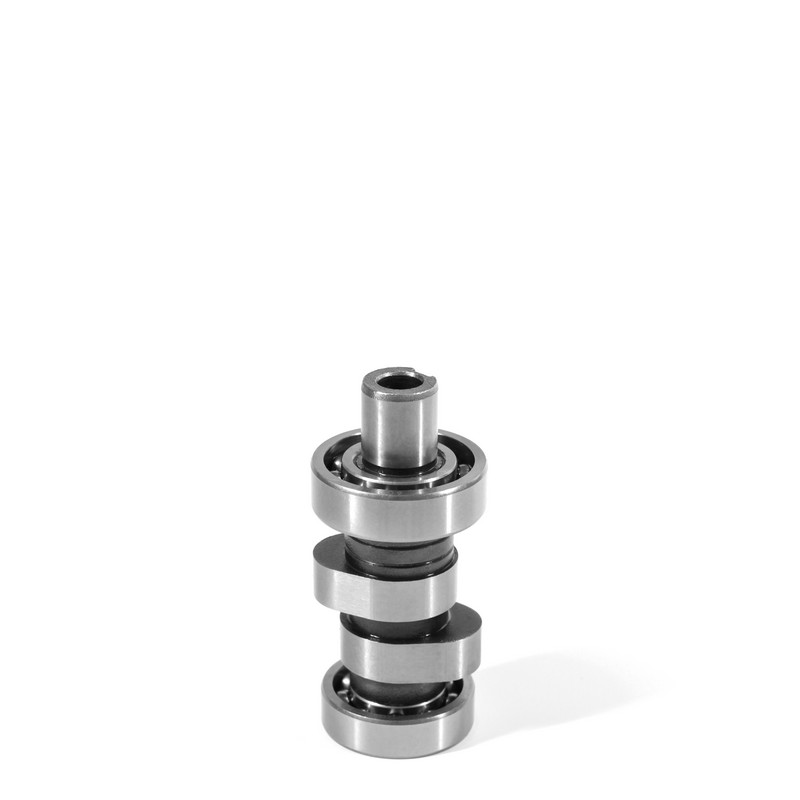 Custom OEM/ODM Motorcycle Camshaft Manufacturers, SuppliersWe Are China Custom OEM/ODM Motorcycle Camshaft Manufacturers, Suppliers And Factory, ANHUI KORBOR Offer Custom Motorcycle Camshaft And L...View Product →
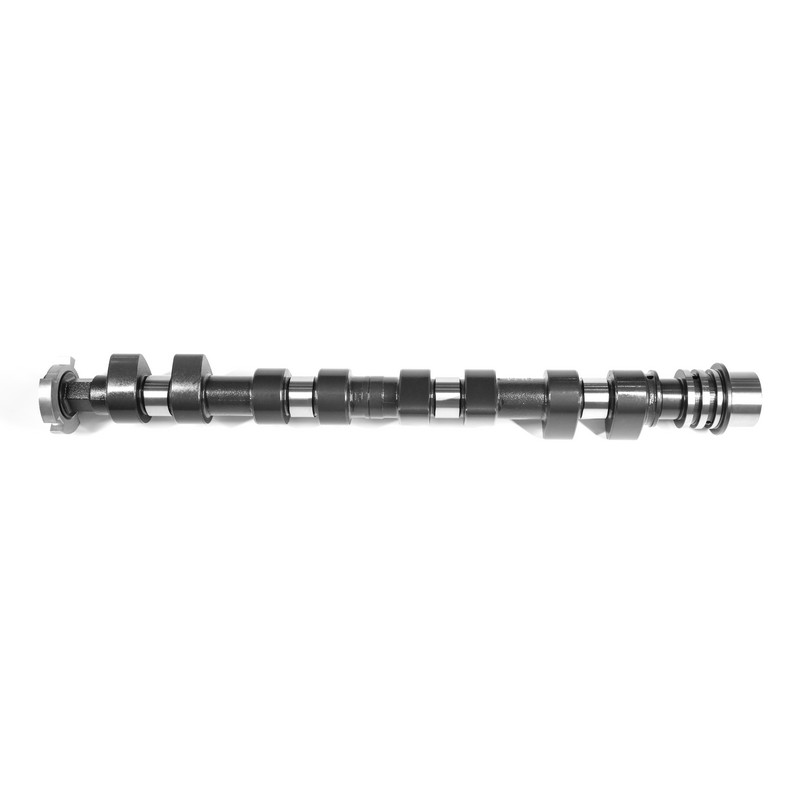 Custom Blank Automobile Camshaft Manufacturers, SuppliersAs China Custom Blank Automobile Camshaft Manufacturers, Suppliers And Factory, KORBOR Offer OEM/ODM Chilled Cast Iron Camshaft, Nodular ...View Product →
Lobe lift tolerance, journal runout, and hardened depth are the three measurements that separate a camshaft that runs quietly for 200,000 miles from one that fails prematurely. Production camshaft lobe lift is normally held to within 0.025 mm (0.001 in) of the drawing; journal runout is typically controlled below 0.02 mm. Poor runout shifts valve timing from lobe to lobe, showing up as rough idle before it becomes a hard failure. The base circle must also be perfectly concentric with the journal axis; an off-center base circle changes the static valve lash on each cylinder and creates the classic one-noisy-cylinder complaint.
KORBOR's quality system follows IATF 16949:2016 with a zero-defect philosophy applied at every production stage. The company operates a 22,000-square-meter plant, ships more than 2.3 million camshafts per year, and runs the full manufacturing chain from blank casting through heat treatment and finish grinding.
Batch-to-batch consistency is the practical benefit that matters most to engine builders and aftermarket distributors. A replacement camshaft must reproduce the original equipment grinding specification exactly; if the lobe flank radius varies, if the base circle is out of round, or if the hardening depth drifts, the engine will not hold the designed valve timing. A dedicated camshaft manufacturer that has focused on this single component since its founding in 1999 - KORBOR was established as a camshaft-only operation - is positioned differently from a general machine shop. Its company history and manufacturing background explain why the engineering team treats camshafts as a specialty rather than a side product.
For engineering buyers evaluating a potential supplier, the documentation that matters is straightforward: lobe profile measurement reports, hardness verification records, runout test data, and a traceable process from foundry casting to final inspection. Every serious camshaft manufacturer should be able to produce these documents. Suppliers who also control casting in-house, with a documented quality management system, tend to deliver the same geometry and hardness from lot to lot, which is what holds an engine's power curve stable across a production run.
The six classic signs of a failing camshaft are valvetrain ticking, rough idle, weak low-end torque, poor fuel economy, load misfires, and metallic particles in the oil. None of these symptoms is unique to the camshaft, so diagnosis should begin with lobe inspection rather than automatic part replacement.
Pre-installation Check
Straightness inspection is the single most useful pre-installation check. A camshaft bent by 0.05 mm scores its journals and can fatigue the cylinder head mountings over time. Checking the shaft for rotational straightness on v-block fixtures before installation prevents a large share of premature valve train failures.
Regrinding is possible when the core remains straight and enough hardened material survives beneath the lobe surface. Performance engine builders routinely regrind in that situation. For a standard replacement, a new camshaft is the safer choice, because grinding removes part of the hardened layer and lowers long-term wear resistance.
In a properly lubricated engine with original valve springs and an intact timing chain, a chilled-cast-iron camshaft normally lasts between 150,000 and 250,000 miles. Early failure before 100,000 miles is almost always caused by insufficient break-in lubrication, a collapsed lifter, or contaminated oil rather than by the material itself.
The three dominant causes are poor lubrication at startup, excessive valve spring pressure, and contaminated oil. Hard particles trapped between the lobe and lifter act like lapping compound, grinding away the hardened surface. This is why oil filter condition is one of the first items checked in any camshaft failure investigation.
The crankshaft converts combustion pressure into rotating torque and drives the camshaft through a timing chain or gear set. The camshaft controls valve events only and carries no combustion load. A bent crankshaft produces vibration and low oil pressure, while a worn camshaft changes airflow and valve timing; the two fail with very different symptom sets.
provide one-stop service from blank casting to finished product finishing, fundamentally control product stability, to ensure delivery.

 English
 中文简体
 русский
 Español




 闽公网安备35018102000203号
