Article Directory
Consider two inquiries that land in the same camshaft plant during the same week. The first is a Tier 1 programme: a twelve-page specification, a request for validation samples, and a requirement that the supplier own blank casting, heat treatment, and final grinding. The second is a private-label engine builder who mails in a worn camshaft and asks for 400 units designed, tested, and packed under their own brand. Same furnaces, same grinders, same inspection gate, two entirely different contracts.
That split is what separates OEM and ODM work in camshaft manufacturing. OEM means the buyer owns the camshaft design and the manufacturer builds to the buyer's drawing under the buyer's part number. ODM means the manufacturer owns the design, validates it, and supplies a finished part that the buyer can adopt as-is or rebrand.
Both routes need the same underlying capability: alloy control, repeatable heat treatment, precision grinding, and batch-level traceability. What changes is who carries the design risk, who funds tooling, and what evidence the buyer is entitled to demand.
In camshaft sourcing, the OEM and ODM labels describe who owns the design and who carries the validation risk. They say nothing about which supplier is better, and a factory that runs both is normal rather than unusual.
The difference surfaces in six specific places, and each one changes how a purchase order is written.
| Decision point | OEM programme | ODM programme |
| Design ownership | Buyer's engineering team | Camshaft manufacturer |
| Input documents | Customer drawing, 3D model, material specification | Sample part, target lift curve, or catalogue reference |
| Tooling and development cost | Paid by the buyer | Absorbed by the manufacturer and recovered in unit price |
| Approval route | APQP with a PPAP submission, audited under IATF 16949:2016 | Fitment check and bench validation, PPAP optional |
| Change control | Buyer engineering change notice governs every revision | Manufacturer controls revision and notifies buyers |
| Branding | Buyer part number and packaging | Manufacturer catalogue number or buyer private label |
An ODM camshaft is a finished product with the manufacturer's validation behind it. An OEM camshaft is your design with the manufacturer's process capability behind it. Requesting identical paperwork for both is how buyers end up with either too little evidence or a supplier who cannot quote.
An OEM camshaft contract is awarded only after the supplier demonstrates process capability on the customer's drawing, not on its own catalogue part. That is why IATF 16949:2016 certification, a documented APQP path, and a PPAP submission are treated as entry requirements rather than selling points.
KORBOR, the brand used by Anhui KORBOR Machinery Co., Ltd. in Susong, Anqing, operates a 28,000 square metre site with 22,000 square metres of production floor and more than RMB 100 million in total investment. The company traces its camshaft work back to 1999, holds IATF 16949:2016 certification, and reports annual deliveries above 2.3 million camshaft sets across a catalogue of more than 800 automotive and more than 600 motorcycle part numbers.
Catalogue breadth matters to an OEM buyer for one reason: it shows the process is repeatable across many distinct part numbers instead of being tuned around a single product.
Four controls carry most of the weight in an OEM camshaft programme.
Because those controls generate the exact evidence an OEM auditor asks for, the quality system behind them is normally reviewed before price is discussed at all.
Process capability is not a certificate. IATF 16949:2016 confirms that a system exists; capability indices on lobe lift, base circle, and runout confirm that the system is holding the customer's tolerance on that specific part number.
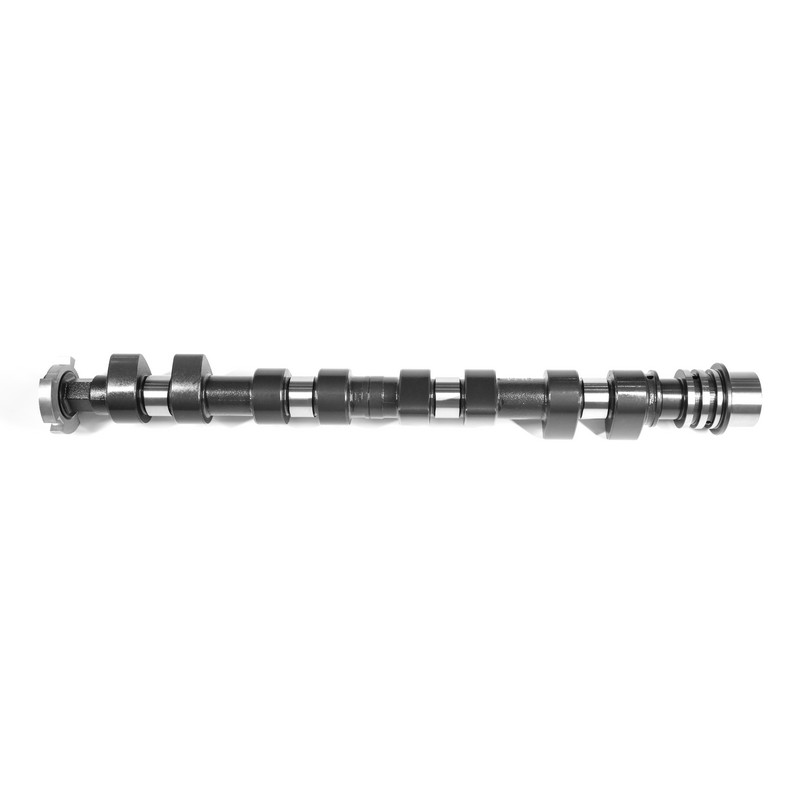 Automotive Camshaft Category for OEM and AftermarketBrowse over 800 automotive camshaft models by brand, OEM reference, engine code, drawing, or sample, with custom blanks and heat-treated alloy steel.View Product →
ODM support moves four development tasks off the buyer's engineering team: profile design, material and heat-treatment selection, prototype tooling, and bench validation. What remains with the buyer is a fitment check, a sample run, and a commercial decision.
On an ODM programme the buyer's engineering budget is limited to a fitment check and a sample sign-off. Every step upstream of that belongs to the manufacturer.
That is the commercial core of the customization work camshaft manufacturers sell: the buyer pays for a validated design instead of funding a development project.
Automotive camshaft customisation is driven by platform volume and emissions compliance. Motorcycle camshaft customisation is driven by short model cycles and small batches. The same plant runs both, but the economics differ sharply.
Catalogue depth is what makes small-batch customisation viable. A manufacturer holding 800 automotive and 600 motorcycle part numbers already owns the tooling, fixtures, and inspection programmes for a wide spread of journal sizes and lobe geometries, so a new variant starts from existing hardware rather than a blank sheet.
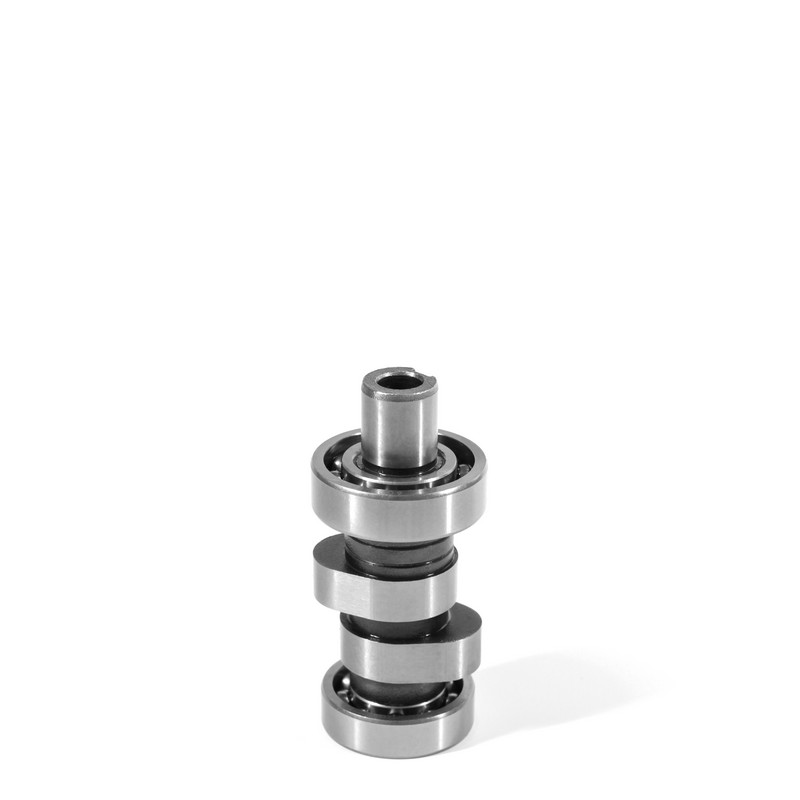 Custom Motorcycle Camshafts for OEM and ODM ProgramsExplore over 600 motorcycle camshafts for Honda, Yamaha, Suzuki and Bajaj, including intake and exhaust options, OEM replacements, performance upgrades and custom profiles.View Product →
Before a camshaft programme is released to series production, the buyer should hold five documents: a dimensional inspection report, a material certificate, a heat treatment record, a hardness result, and a surface finish reading. Each one answers a different failure question.
| Document | What it proves | Standard or reference |
| Dimensional inspection report | Lobe lift, base circle, and camshaft runout inside drawing limits | ISO 1101 geometrical tolerancing |
| Material certificate | Alloy grade matches the declared heat number | EN 10204 type 3.1 |
| Heat treatment record | Tempering, carburising, and quenching parameters for the batch | AIAG CQI-9 heat treat assessment |
| Hardness result | Lobe and journal hardness measured on the finished part | ASTM E18 Rockwell C |
| Surface roughness reading | Lobe finish expressed as Ra, protecting the follower interface | ISO 4287 |
| PPAP submission | Capability demonstrated on the buyer's specific part number | AIAG PPAP with IATF 16949:2016 |
Hardness without a batch number is a number, not evidence. Traceability is the control that turns a test result into a sourcing decision.
Design ownership. On an OEM programme the buyer owns the drawing, funds tooling, and routes every revision through its own engineering change process. On an ODM programme the manufacturer owns the design, absorbs tooling cost, and controls revisions while notifying buyers of each change.
Yes, and most established camshaft manufacturers do. The requirement is separation, not choice: separate drawings, separate tooling records, and separate inspection plans. IATF 16949:2016 expects customer-specific requirements to be documented per customer, which is what keeps the two streams from contaminating each other.
Enough coverage to make small batches economic. A supplier carrying 1,400 or more camshaft part numbers across automotive and motorcycle applications already owns fixtures and inspection programmes for a wide range of journal sizes, so a 300-piece custom run reuses existing setup instead of funding new tooling.
Ask who will own the drawing. That single answer determines tooling cost, the validation route, the documentation you are entitled to receive, and how fast a revision can be executed. Every other commercial term follows from it.
provide one-stop service from blank casting to finished product finishing, fundamentally control product stability, to ensure delivery.

 English
 中文简体
 русский
 Español




 闽公网安备35018102000203号
