Article Directory
A camshaft lot that drifts 0.02 mm on the lobe flank after PPAP approval is not a routine quality notification — it is a production stop, a timing-chain rework, and a warranty exposure that runs into six figures.
Procurement teams rarely set out to buy risk. But when a camshaft is sourced on piece price alone, the factors that protect the program — print control, metallurgical stability, process capability, and delivery depth — are exactly the factors that get negotiated away. Anhui KORBOR Machinery Co., Ltd. (KORBOR) has manufactured camshafts exclusively since 1999, and today ships over 2.3 million camshaft sets a year from a 22,000-square-meter workshop in Anqing, China. The decision framework below is the one KORBOR applies with OEM buyers who expect a component to stay identical for the life of the engine program.
Core definition
A camshaft is the engine component that controls valve lift, duration, and timing. Every valve-train event is locked into the precision geometry of its lobes and the hardness of its running surfaces, which is why camshaft sourcing is a metallurgical decision as much as a machining one.
The engineering print is the most important document in camshaft procurement; a supplier that cannot hold the print across consecutive production lots fails every other qualification step by definition.
Camshaft lobes operate under concentrated contact stress between the lobe and the follower, so OEM prints combine dimensional limits with metallurgical requirements. The minimum callouts for a long-term supply agreement are:
A supplier with a wide library of proven prints reduces first-time manufacturing risk. KORBOR runs more than 800 automotive camshaft models and 600 motorcycle camshaft models — over 1,400 verified prints in active production — so the geometry your engine requires is likely a mastered process rather than a development project. A Ford camshaft application, for example, is controlled against a print that specifies every lobe and journal feature before the first sample is cut.
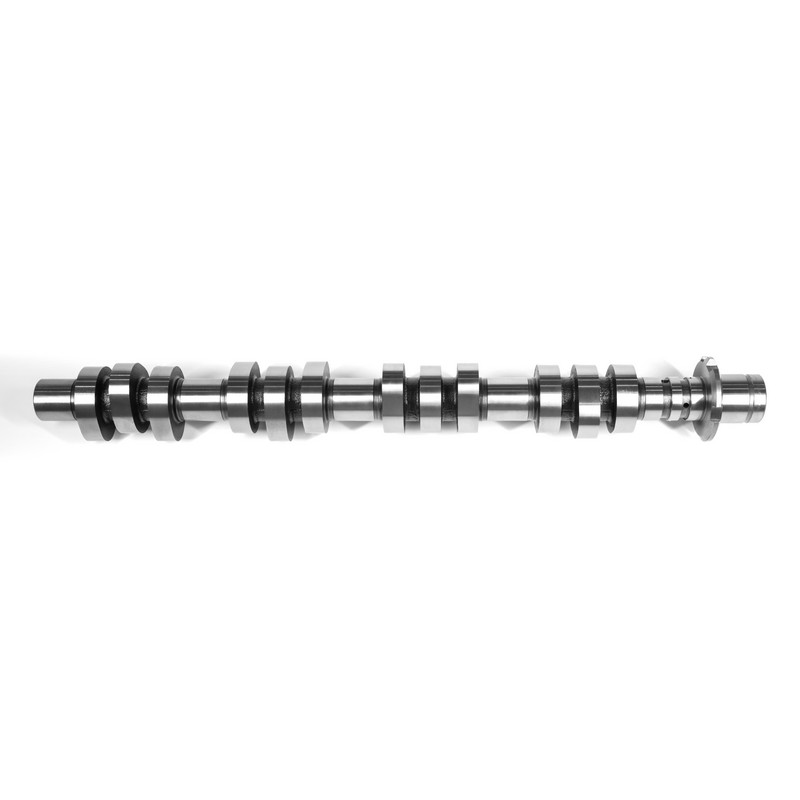 Ford 9L3Z6250C Camshaft Assembly for 5.4L 3-Valve V8 EnginesThis OE camshaft for Ford 5.4L 3V V8 engines is a proven, mastered print in active production, reducing first-time manufacturing risk. Its hardened steel and CNC-machined lobes support reliable valve timing and durability.View Product →
Material choice and in-house heat treatment determine whether a camshaft survives the full program or becomes a repeat warranty item — outsourced blanks turn metallurgy into a supply risk that final inspection cannot catch.
Production camshafts split three ways in practice. Chilled cast iron delivers a hard, wear-resistant lobe face at a low piece price. Nodular cast iron adds ductility for diesel and commercial-vehicle loads. Carburized alloy steel carries the highest contact loads in turbocharged gasoline engines.
| Material | Lobe hardness | Typical application | Main supply risk |
| Chilled cast iron | 45-55 HRC | Entry passenger engines | Chill depth consistency |
| Nodular cast iron | 40-48 HRC | Diesel and commercial vehicles | Nodularity and pearlite level |
| Carburized alloy steel | 58-62 HRC | Turbocharged gasoline engines | Carburizing depth uniformity |
The procurement test is whether the supplier controls the blank. If casting and heat treatment are subcontracted, hardness drift and distortion are discovered only after machining, when scrap cost is already locked in. KORBOR operates a one-stop chain from blank casting to the finished camshaft, applying tempering, carburizing, and quenching internally to stabilize hardness and minimize distortion. A Volkswagen application that requires deep case hardness is a typical case where internal heat-treatment control keeps the print achievable in volume.
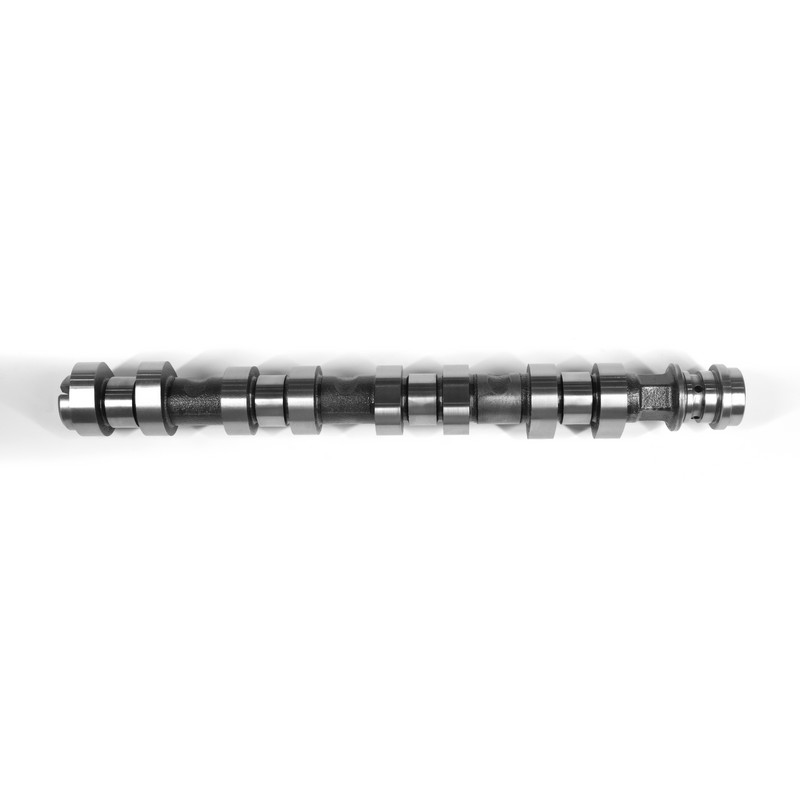 KORBOR 032109101AG Camshaft with In-House Heat TreatmentThis automotive camshaft benefits from KORBOR's internal casting, tempering, carburizing, and quenching, ensuring stable hardness and minimal distortion. It demonstrates the one-stop metallurgical control that makes volume production of demanding engine parts feasible.View Product →
If a camshaft supplier cannot show heat-treatment furnace records with matching batch traceability, the metallurgy of the certified part is unverifiable. Treat that as a disqualifying gap.
Long-term OEM supply is sustained by an IATF 16949 quality system with in-process control — not by final inspection at the shipping dock.
KORBOR follows IATF 16949:2016 with a zero-defect production philosophy, applying multi-layer quality control at every step so that each batch reproduces the same dimensional and metallurgical result. KORBOR's full quality assurance process covers blank casting, machining, heat treatment, and final measurement. When you audit a camshaft supplier, the quality system should demonstrate:
"The last twelve months of SPC charts separate a genuine manufacturer from a trading desk. One produces the data; the other cannot."
Delivery reliability on OEM call-offs is the product of installed capacity, integrated production depth, and a documented record of shipping at volume — it is not a promise made in a commercial review.
KORBOR operates a 28,000-square-meter site with a 22,000-square-meter workshop, a scale that supports multi-year schedules without single-line fragility. Its production capacity is backed by a registered capital of RMB 11 million and a total investment above RMB 100 million, with annual deliveries exceeding 2.3 million sets.
For OEM buyers, this depth matters because a specialist that makes its own blanks and runs its own heat treatment can absorb schedule pressure without pushing metallurgical risk onto the customer. Continuous programs — including a Nissan camshaft family produced by KORBOR — depend on this kind of stable capacity.
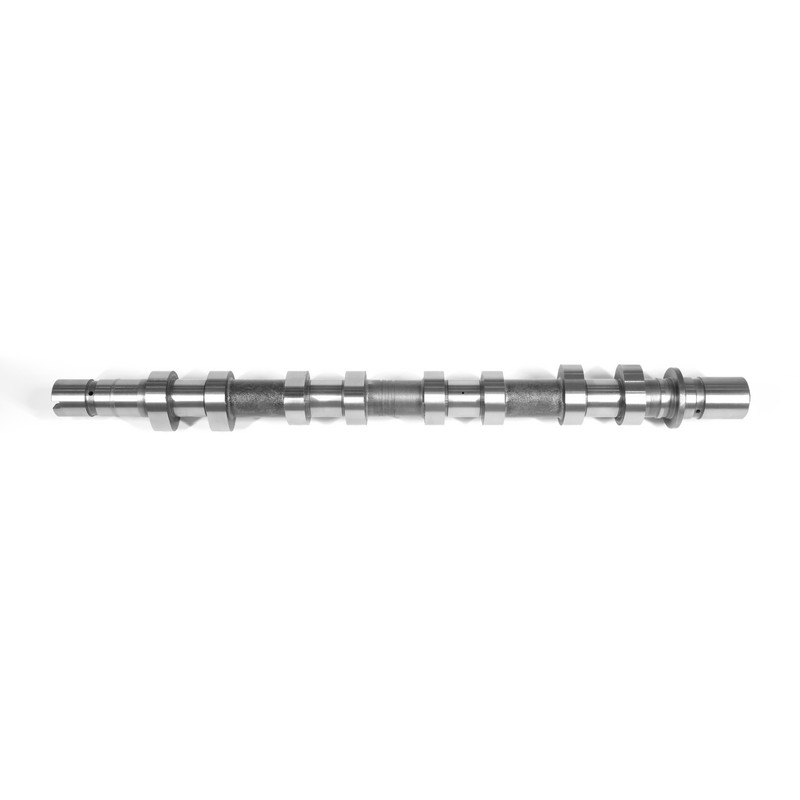 KORBOR 130209419R Camshaft for Continuous Production ProgramsThis Nissan-family camshaft represents stable capacity built on in-house blank making and heat treatment, absorbing schedule pressure without shifting metallurgical risk. Reliable batches help avoid line stops and warranty claims over the program's life.View Product →
The true cost of a camshaft supplier is the sum of piece price, incoming inspection, line stops, warranty claims, and expedite freight over the life of the program; a low per-unit quote cannot survive a single engine-line stoppage.
In high-volume engine assembly, one camshaft lot with dimensional drift stops the line for sorting, rework, or re-sequencing. The distribution below reflects the typical causes found in production camshaft audits — process drift and metallurgy dominate, not logistics errors.
When you compare camshaft suppliers, weight the dimensions below — a qualified specialist should outperform a low-priced trader in every row except the unit price.
| Cost dimension | Transactional vendor | OEM-qualified specialist |
| Incoming inspection | Frequent sorting and re-measurement | Skip-lot or reduced inspection |
| Line-stop exposure | Recurring dimensional drift between lots | Stable Cpk on lobes and journals |
| Warranty risk | Hardness variation without furnace records | Traceable batch-level heat-treatment data |
| Engineering support | Reactive and limited | Application review before PPAP |
Total cost of ownership
Total cost of ownership (TCO) in camshaft procurement is the sum of every cost triggered by the component after arrival: inspection hours, assembly rework, line stoppages, field warranty claims, and the freight of emergency replacement lots.
A repeatable qualification process removes supplier rhetoric from the decision — each step below closes one specific supply risk.
KORBOR supports this qualification path with documented process data, production capacity reviews, and PPAP samples across its 1,400+ model library.
Print compliance under repeat production. Geometry, hardness, and batch consistency matter more than piece price, because a failed camshaft creates line stops and engine warranty costs that far exceed any negotiated saving.
For long-term OEM supply, yes. In-house blank casting and heat treatment keep chill depth, carburizing depth, and final hardness under direct control, with batch-level furnace records for traceability.
Review twelve months of SPC charts, require CMM reports and hardness data for three consecutive PPAP lots, and audit material certificates from the foundries feeding the casting line.
Expect a specialist with integrated production to commit to multi-year schedules. KORBOR, for example, ships more than 2.3 million sets per year from a 22,000-square-meter manufacturing floor on a 28,000-square-meter site.
provide one-stop service from blank casting to finished product finishing, fundamentally control product stability, to ensure delivery.

 English
 中文简体
中文简体 русский
 Español



 闽公网安备35018102000203号