Article Directory
A purchasing manager sends an RFQ for 8,000 camshafts with only an engine code and an OEM part number. Within a week, quotes come back with prices that differ by 20 percent or more, hardness values that contradict each other, and lead times that range from six to eighteen weeks. The problem is rarely a dishonest supplier. It is an RFQ that failed to specify what was actually being bought.
An RFQ, or request for quotation, is a formal procurement document that states the technical, quality, and commercial conditions a supplier must satisfy before a contract is awarded. In camshaft bulk purchasing, that document is the only binding reference for everything that follows: sample approval, first article inspection, mass production, and incoming goods checks. Buyers who leave gaps give suppliers the freedom to choose the cheapest interpretation, and the cost of that freedom appears later as lobe wear, valve timing drift, and rejected batches.
Anhui KORBOR Machinery Co., Ltd. (KORBOR), a camshaft-only manufacturer with more than 25 years of production history, evaluates thousands of sourcing inquiries every year. The pattern is consistent: the RFQs that produce the smoothest procurement process are not necessarily the longest. They are the ones that state measurable limits instead of leaving them open to interpretation.
A vague camshaft RFQ produces inconsistent pricing, unpredictable quality, and avoidable downtime at the assembly line.
Camshafts sit inside the engine and control valve opening and closing. A change in lobe profile, material, or hardness changes torque output, fuel consumption, and wear behaviour. When the RFQ omits these parameters, every supplier prices a different part, and the buyer cannot compare quotes because they are not for the same product.
The two columns below show what buyers typically receive in each situation.
Seven specification blocks form the minimum skeleton of a professional camshaft RFQ, and each block must contain a measurable value or a reference to an approved drawing.
These blocks cover the complete chain from part identity to delivery verification. Omitting any one of them forces the supplier to fill a technical gap with a guess, and that guess becomes part of the contract price.
| Specification block | What to state | Why it matters |
| Part identity | Engine family, OEM part number, displacement, model year | Confirms lobe profile and valve timing match the engine |
| Blank material | Chilled cast iron, nodular cast iron, alloy steel, or forged blank | Sets the strength, wear mode, and cost baseline |
| Heat treatment | Quenching, tempering, carburizing, or nitriding; hardness range in HRC | Controls surface durability against lobe pitting |
| Lobe geometry | Lift, duration, lobe centerline angle, or drawing reference | Determines the power curve and valve train stability |
| Dimensional tolerances | Journal diameter grade, journal width, keyway tolerance | Ensures oil clearance and press-fit assembly behaviour |
| Runout and straightness | Maximum total indicated runout on journals and lobes, straightness limit | Prevents vibration, noise, and uneven wear |
| Inspection and reporting | CMM report, hardness certificate, material certificate, PPAP level | Provides objective evidence that the batch meets the RFQ |
PPAP, or Production Part Approval Process, is the automotive industry's standard procedure for confirming that a supplier's production process can consistently deliver parts that meet the drawing before mass production starts.
For automotive rebuilders, the OEM cross-reference matters more than any other single field. A Toyota engine application, for example, is one of the most frequently requested references in the catalogue; quoting the OEM part number in the RFQ removes ambiguity before pricing starts.
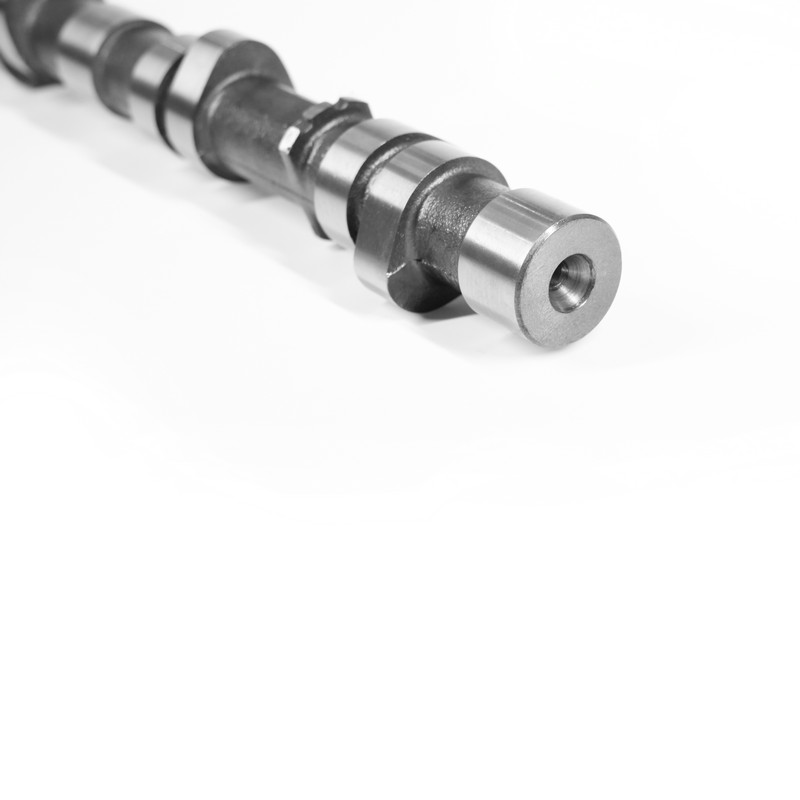 Toyota KB-014 Overhead Camshaft for 2.2L/2.4L EnginesThis OEM-cross-referenced camshaft suits Toyota Celica, Corona, and Pickup models from the covered years. Its material grade and heat treatment directly affect service life, making it a critical specification to fix before comparing prices.View Product →
Material grade and heat treatment are the two specifications with the largest influence on camshaft service life, and both must be fixed before price comparison begins.
Each material family suits a different operating condition. Chilled cast iron is common in cost-sensitive, high-volume passenger engines because its hard wear surface forms during casting. Nodular cast iron offers higher bending strength and tolerates moderate shock loading. Alloy steel that is carburized and quenched is used when surface hardness and core toughness both need to be high, typically in performance and diesel applications.
KORBOR's integrated production chain begins with blank casting and continues through tempering, carburizing, and quenching to reach the strength, hardness, and wear resistance required by each engine family. When an RFQ names both the material family and a hardness range, the supplier cannot substitute a cheaper blank without breaching the contract.
Write the hardness as a range, not a minimum. A statement such as 48 to 52 HRC on the lobe surface gives the supplier a controlled process window; a statement such as minimum 48 HRC invites borderline batches that still pass but perform inconsistently.
Tolerances on journal diameter and lobe runout are the measurements that separate a reliable camshaft from an early failure.
Typical production values in the industry include journal diameter tolerances at ISO fit grades such as f7 or h8, total runout on the journals at or below 0.02 mm, and straightness over the whole length within 0.02 mm. Surface finish on bearing journals is usually specified in Ra values, with 0.4 micrometres common for oil film retention. These numbers need to be written explicitly because they decide whether the camshaft spins without noise and holds valve lash within specification.
A part that passes diameter measurement can still carry hidden centreline deviation. That is why the RFQ should require runout measurement on centres, plus a straightness check after finish grinding.
A bulk camshaft supplier must demonstrate a functional quality system, not just a calibration certificate.
Buyers should ask for the quality standard by name. KORBOR operates under IATF16949:2016, the automotive-specific quality management standard that adds process control, risk analysis, and supply chain requirements to ISO 9001. The company applies layered quality checks at every production stage, with batch-to-batch consistency as the target, and its stated annual output exceeds 2.3 million camshaft sets. That volume matters: a line built for millions of pieces behaves differently from a workshop that machines single prototypes.
For inspection and traceability, the RFQ should require a dimensional report from a coordinate measuring machine, a hardness test certificate, and a material certificate for each batch. If the parts are destined for an OEM production line, the buyer should also name the required PPAP level so the supplier prepares the correct documentation package.
KORBOR's stated quality commitment is identical performance across every batch, supported by multi-level control of incoming material, machining, heat treatment, and final inspection before packing.
Buyers who want to verify these claims before writing the RFQ can review the quality-related capabilities and control processes on KORBOR's quality assurance overview page.
For high-volume motorcycle engine lines, camshaft batches are often counted in thousands of units. The RFQ for such orders must name the OEM reference and the inspection standard together, because the cost of a single bad lot in a motorcycle engine program is multiplied by the number of vehicles already assembled.
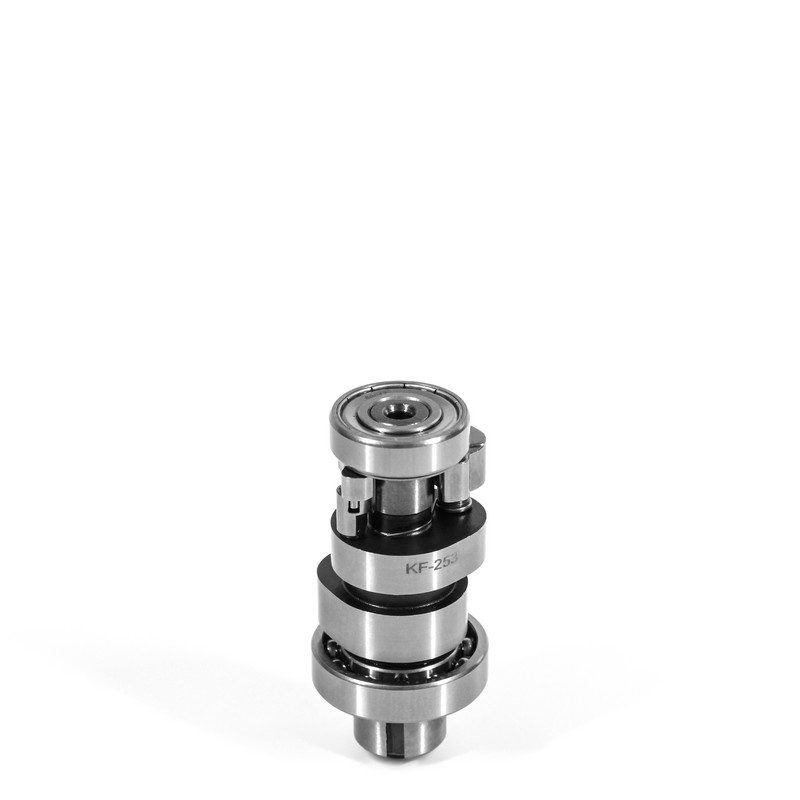 Honda 14100-KWW-741 Camshaft for WAVE-110 SeriesAn OEM-spec replacement for Honda WAVE-110 motorcycle engines, this camshaft is built for high-volume orders and requires naming the OEM reference and inspection standard in the RFQ to avoid costly batch defects.View Product →
Delivery terms and packaging rules belong in the RFQ because they determine whether a bulk order arrives usable and on schedule.
Bulk camshaft orders are normally packed with anti-rust oil, individually sleeved or wrapped, and laid in export cartons on wooden pallets. The RFQ should state the accepted rust-preventive oil type, whether phosphate or other coatings are forbidden, the number of pieces per carton, and the pallet marking scheme. Lead time needs equal precision: a monthly call-off of 5,000 sets creates a different production plan than a single annual delivery of 60,000 sets.
Supplier qualification goes beyond the drawing. The buyer should verify that the manufacturer owns the complete process chain instead of outsourcing critical operations. KORBOR's one-stop service covers everything from blank casting to the finished camshaft, and its production base in Anhui occupies 28,000 square metres, with 22,000 square metres of workshop area. Annual contract capacity and buffer stock policy should be written into the RFQ so both sides share the same planning assumption.
Since its founding in 1999, KORBOR has focused exclusively on camshafts. That single-product focus is visible in its catalogue coverage and in the process development history described in the company profile.
Buyers sourcing Ford engine parts face a particular challenge: Ford has used several distinct camshaft families across different engine generations, so the OEM cross-reference must be exact before sampling begins.
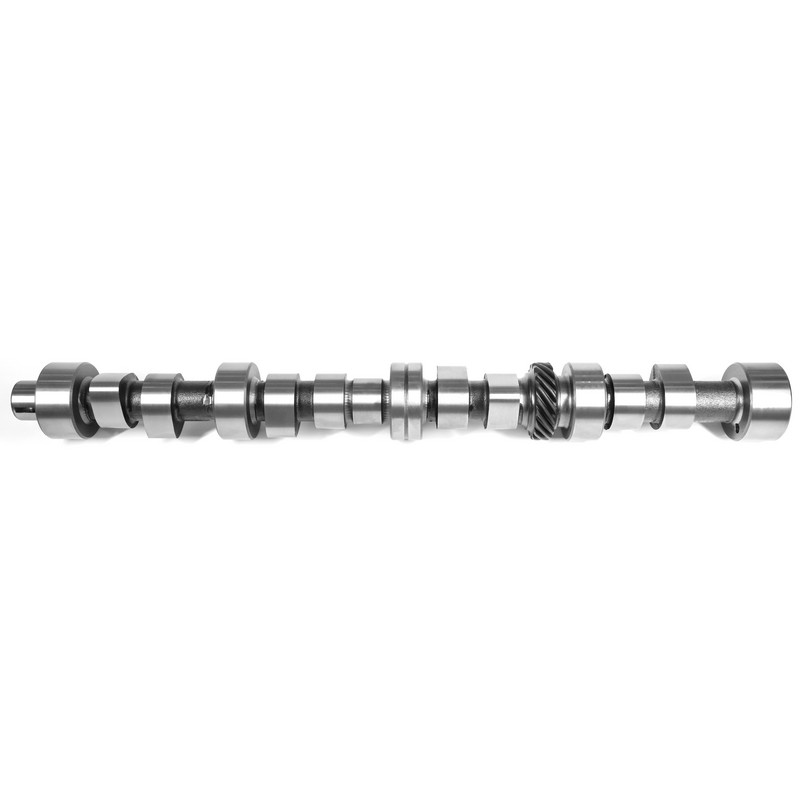 Ford C7NN6250B Tractor Camshaft for 5000-6600 SeriesFor Ford engine rebuilders, this camshaft serves multiple tractor models but demands an exact OEM cross-reference before sampling, as Ford used distinct camshaft families across generations and applications.View Product →
Short answers to the questions buyers most often raise before issuing a camshaft RFQ.
The minimum set is engine identity, OEM part number, material family, heat treatment and hardness range, lobe geometry reference, journal and lobe tolerances, runout limits, surface finish, inspection report requirements, packaging, and delivery terms.
Chilled cast iron is the most common choice for high-volume passenger car camshafts because it combines a hard wear surface with economical casting. For higher strength and shock resistance, nodular cast iron or carburized alloy steel is specified.
Ask for the quality certificate by name, ideally IATF16949:2016, and require a first article inspection report with CMM data. A site audit should check the heat treatment line, the finish grinding process, the measurement room, and the batch traceability system.
Lead time depends on whether the part is a stocked catalogue model or a new tooling project. Standard references, such as the 1,400-plus models in KORBOR's catalogue, ship faster than new lobe profiles that require tooling development and sample approval.
provide one-stop service from blank casting to finished product finishing, fundamentally control product stability, to ensure delivery.

 English
 中文简体
中文简体 русский
 Español



 闽公网安备35018102000203号