Article Directory
Car and motorcycle camshafts are not scaled versions of the same part, and swapping one between platforms fails at the first measurement. On a 2.0-liter inline-four compared with a 600cc four-cylinder sport bike, journal diameter, lobe lift curve, drive interface, and heat treatment all diverge by design, because the two engines operate in completely different speed and load regimes.
A camshaft is the rotating shaft with eccentric lobes that opens intake and exhaust valves at precise crankshaft angles. Its lobe profile, journal size, and drive layout determine where the engine produces torque, how high it revs, and how reliably it survives sustained operation. This definition anchors both product families, and almost every measurable difference between a car camshaft and a motorcycle camshaft traces back to this core function.
The differences matter to engine builders and procurement teams because choosing the wrong cam geometry costs more than horsepower; it risks valve float, piston-to-valve contact, and timing-chain failure. Anhui KORBOR Machinery Co., Ltd., which operates under the KORBOR brand from a 28,000-square-meter facility in Anhui Province, manufactures both product lines in the same factory, with casting, heat treatment, and machining integrated under one quality system. The engineering separation between the two lines is strict, intentional, and visible in every part number.
Core rule: car camshafts optimize low-speed torque, emissions, and durability; motorcycle camshafts optimize high-RPM breathing and throttle response. Every design choice below follows from that split.
Cylinder count, bore spacing, and valvetrain layout determine camshaft length, journal count, and mounting position before any performance tuning is considered.
Car engines typically use three to eight cylinders with wide bore spacing, so their camshafts are long and carry multiple bearing journals. A modern four-cylinder car with double overhead cams uses two camshafts, each roughly 400 to 500 millimeters long and supported by five journals. A pushrod V8 places a single camshaft inside the engine block, where it actuates valves through lifters and pushrods over a total length near 600 millimeters.
Motorcycle engines compress the same architecture into much smaller cases. A single-cylinder thumper runs one camshaft, a parallel twin runs one or two, and a 600cc inline-four runs four camshafts in a package that fits between the rider's knees. Individual motorcycle camshafts are shorter, use smaller journal diameters, and are often supported by fewer bearings because the load path is shorter.
Journal geometry alone separates the two families: a typical passenger-car cam journal measures roughly 25 to 35 millimeters, while a compact motorcycle cam journal is often 20 to 28 millimeters. Bearing width follows available cylinder-head real estate, and these dimensions are not interchangeable between platforms even when the lobe design looks similar in a catalog photo.
For automotive applications, KORBOR maintains more than 800 car camshaft models covering Asian, European, and North American engine families; the motorcycle line spans more than 600 models for Honda, Yamaha, Suzuki, Kawasaki, Bajaj, TVS, Sanyang, and Lifan platforms. The separate catalogs exist because a cam that fits a Civic engine is meaningless to an R1 engine.
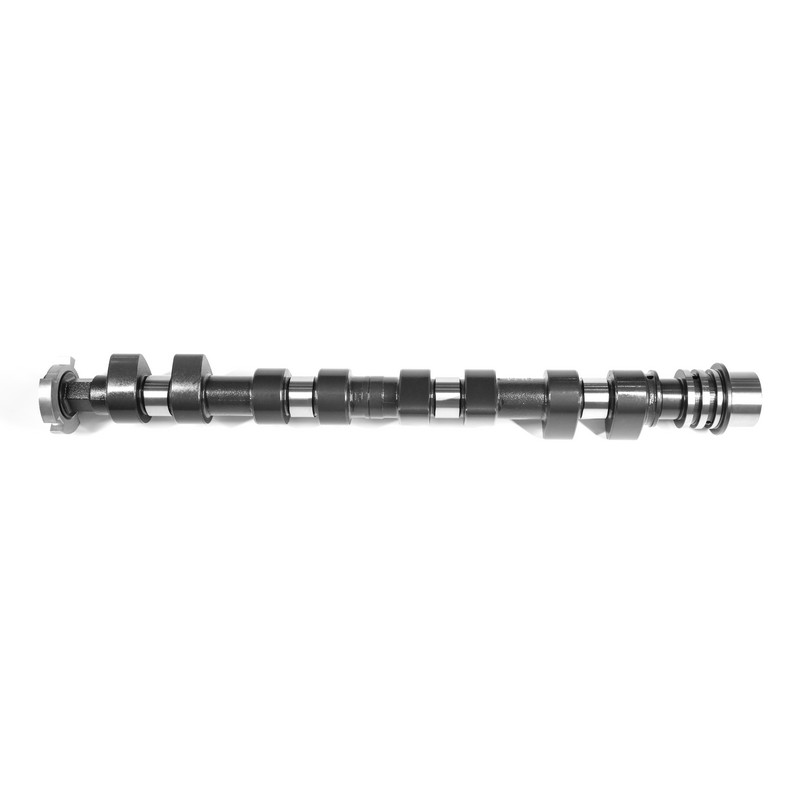 Blank Automobile Camshaft Manufacturers with Extensive Model CoverageThis catalog covers over 800 car camshaft models for Asian, European, and North American engines, making it a practical reference for finding the correct blank camshaft for replacement or custom builds.View Product →
Camshaft definition: a shaft with eccentric lobes that converts rotational motion into linear valve lift, timed in relation to crankshaft rotation. The lobe's base circle, nose radius, and ramp angle define the valve acceleration curve, which is the physical limit of engine speed.
Operating speed is the biggest single difference between the two camshaft families, and it forces entirely different lobe acceleration limits and valvetrain margins.
Most production car engines peak between 5,500 and 7,500 rpm. At those speeds, valve-spring pressure and lobe ramp rates stay moderate, which keeps friction low and idle quality smooth. Cars also compensate for a narrow cam design with variable valve timing: phasers shift the intake and exhaust cams to cover idle, midrange, and high-rpm operation with one physical lobe profile.
Motorcycle engines, especially four-cylinder sport models, routinely turn 10,000 to 15,000 rpm. At 12,000 rpm, the intake valve opens and closes 100 times per second, and the valvetrain must be stiff enough to return the valve fully to its seat at that rate. Lobe ramps are steeper, valve springs are stronger, and the margin before valve float is much thinner. Motorcycle camshafts therefore demand tighter manufacturing tolerances on lobe profile and surface finish than the average car camshaft.
| Parameter | Car engine application | Motorcycle engine application |
| Typical redline | 5,500 to 7,500 rpm | 8,000 to 15,000 rpm |
| Valve float risk | Moderate | Critical above 10,000 rpm |
| Variable valve timing | Widespread | Limited to select models |
| Typical cam drive | Chain or belt | Chain or gear |
| Lobe profile priority | Low-end torque and emissions | High-RPM airflow and response |
Timing error costs grow with speed. One crankshaft degree lasts about 83 microseconds at 2,000 rpm but only 14 microseconds at 12,000 rpm, a sixfold reduction in the time window a lobe profile gives to the valve event. That is why a motorcycle camshaft's grinding tolerance and cam-card accuracy matter far more than in a low-speed industrial engine.
100 valve openings per second per valve at 12,000 rpm
A 1-degree cam timing error is six times more expensive in real time on a 12,000 rpm motorcycle engine than on a 2,000 rpm car engine.
Camshaft drive selection follows engine geometry: motorcycles can use gear trains because the crank-to-cam distance is short, while cars mostly use chains or belts because the distance is long and noise isolation matters.
In a motorcycle engine, the crankshaft and camshaft sit close together inside a compact case, so a gear train with two or three idler gears transfers rotation without stretch or slip. Gear drives never require timing-chain tensioners, never stretch, and hold valve timing to exact tooth geometry at extreme RPM. That is why gear-driven camshafts are common on motocross singles, V-twins, and several sportbike designs.
A car engine's camshaft sits far from the crank, and routing a rigid gear train around water jackets, oil galleries, and accessory drives is impractical. Chains handle long and variable distances with sprockets and hydraulic tensioners; belts add low cost and quiet operation but require scheduled replacement. The trade-off is maintenance: chain stretch and belt wear shift valve timing gradually, while a gear drive keeps timing fixed for the life of the engine.
When a motorcycle tuner says the cam timing "never moves," they are usually describing a gear-drive system. The same statement is never true for a rubber belt carrying 400,000 kilometers of duty cycles.
Production car camshafts are usually cast from chilled iron or nodular iron for low unit cost and excellent wear, while high-RPM motorcycle camshafts are increasingly cut from steel billet or carburized steel to survive aggressive lobe acceleration.
Chilled cast iron produces a hard white-iron surface on the lobe tip through rapid cooling in the mold, giving long wear life with quiet operation. Nodular, or ductile, iron adds toughness and is common in both car and heavy-duty applications. When engineers need higher lobe lift with steeper ramps, they move to steel: hardened steel billet cams are standard in racing cars and motorcycle performance lines where spring pressure at 12,000 rpm would crack a cast-iron lobe.
Heat treatment decides the result. KORBOR applies tempering, carburizing, and quenching to build case depth and core toughness, then machines the base circle and lobes to finished tolerances. Because the company runs casting through machining in one factory, lobe hardness and journal concentricity are controlled in the same process flow, which is the main reason batch consistency holds across both product lines.
Typical maximum engine speed by application
Motorcycle camshafts from the KORBOR motorcycle line, covering Honda, Yamaha, Suzuki, Kawasaki, Bajaj, and Lifan platforms, are manufactured with the same material discipline but tighter lobe-profile tolerances than their car equivalents. The 600 available motorcycle models reflect the fragmented nature of the market: small batches, frequent profile changes, and little tolerance for runout or straightness error.
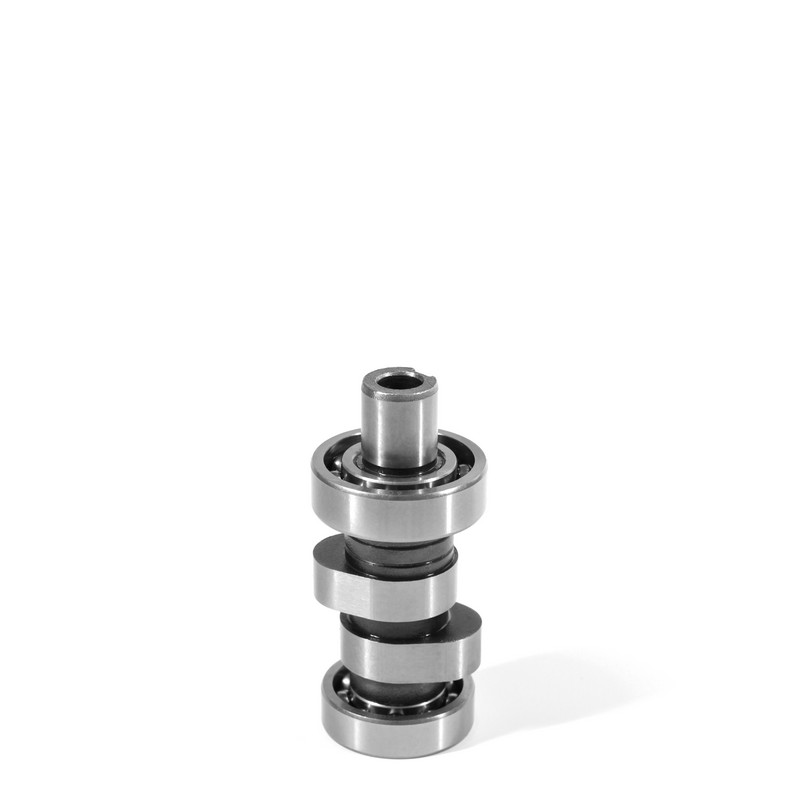 Motorcycle Camshaft Manufacturers with Tight Lobe TolerancesWith more than 600 models for major motorcycle brands, this line emphasizes precise lobe profiles and minimal runout, suitable for small-batch, high-accuracy valvetrain requirements across diverse platforms.View Product →
Lobe profile is the tunable heart of both camshaft families, but the objective differs: car cams chase broad torque and emissions compliance, motorcycle cams chase throttle response and high-RPM breathing.
Duration, lift, and lobe separation angle form the core geometry. Long duration keeps the valves open longer for top-end airflow but hurts idle and low-speed torque; a narrow lobe separation angle increases overlap for high-RPM cylinder filling at the cost of idle stability and emissions. On a car, variable valve timing masks these trade-offs, so aftermarket cams can be more aggressive without ruining daily drivability. On a motorcycle there is usually no phaser, so the cam alone must balance midrange driveability with top-end power.
Street riders rarely benefit from a radical high-lift cam. Mild motorcycle cams often outperform aggressive units in real riding because the usable rev range sits in the midrange; peak horsepower on a dyno does not translate to acceleration if the rider has to drop three gears to stay on the cam. The same principle applies to street cars, which is why many engine builders prefer a moderate performance cam with stock valvetrain compatibility.
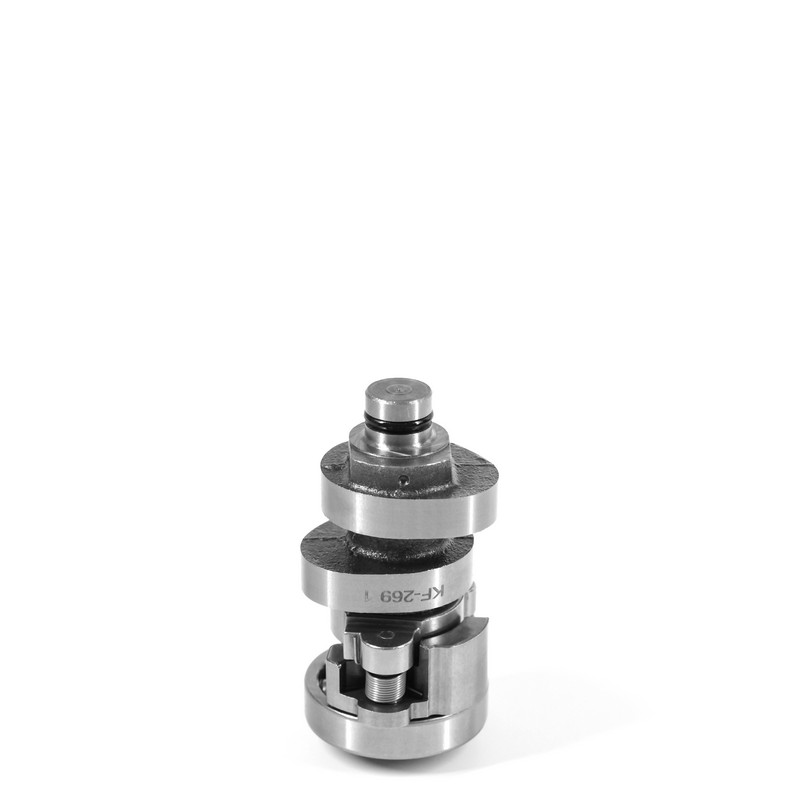
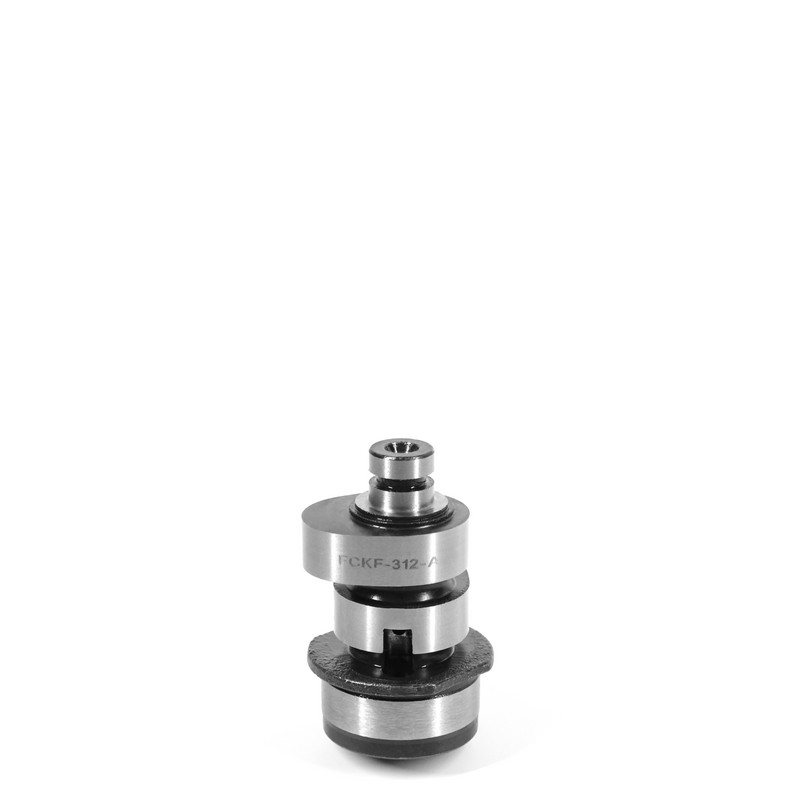
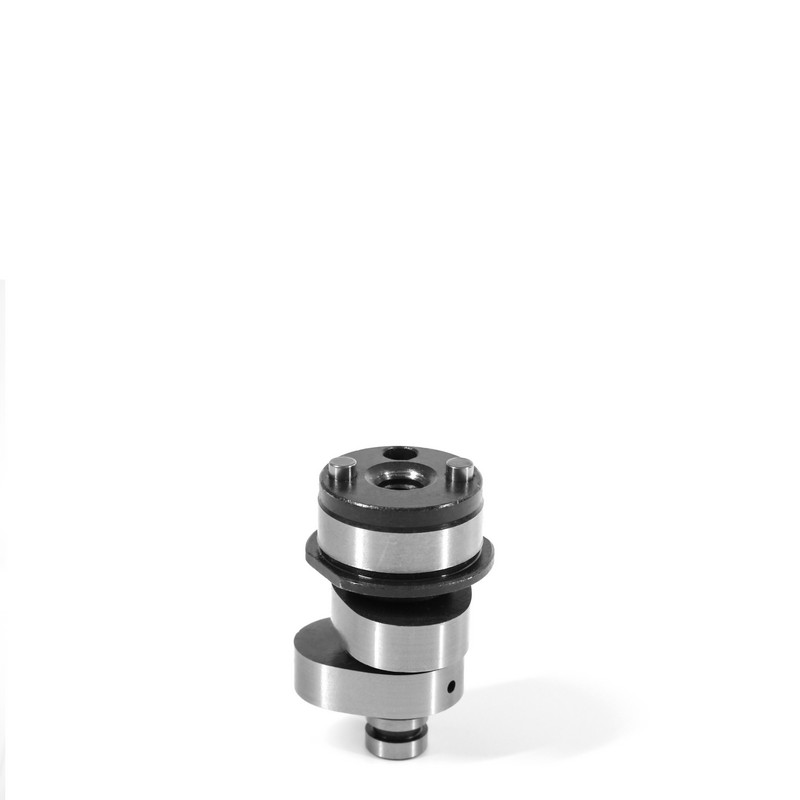
For high-revving platforms, a proven profile such as KORBOR's Yamaha camshaft series shows how lobe design shifts power delivery while keeping stock valve-spring limits in view.
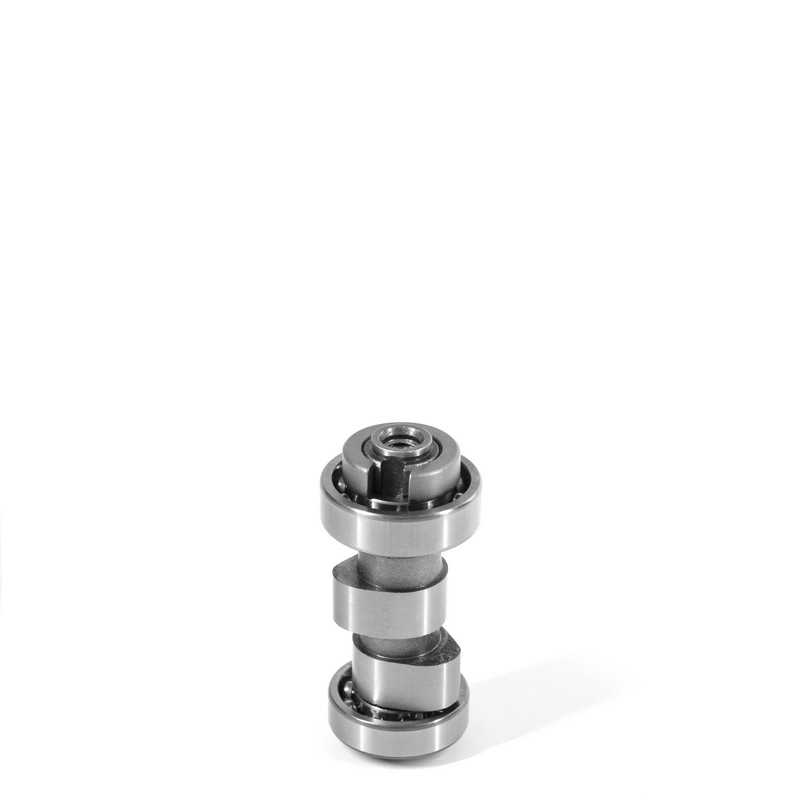 Yamaha 4GT-E2170-01 Motorcycle Camshaft for High-RPM TuningThis genuine-pattern camshaft is highlighted as a proven profile for high-revving Yamaha engines, offering a way to shift power delivery while respecting stock valve spring limits during tuning.View Product →
1,400+
combined car and motorcycle camshaft part numbers at KORBOR, each with a defined lobe card, heat treatment class, and application range. "Close enough" is not a camshaft specification.
A single quality system can serve both automotive and motorcycle camshaft lines when casting, machining, and inspection are integrated in one factory.
KORBOR follows IATF 16949:2016 with a zero-defect philosophy, running multilayer inspection at every production stage from blank casting to final packaging. The company's total investment exceeds 100 million RMB, with 22,000 square meters of workshop floor, and annual output of more than 2.3 million camshafts gives procurement teams a stable supply base for both product lines.
One-stop manufacturing changes sourcing risk. Instead of coordinating a casting supplier, a heat-treatment shop, and a machining vendor separately, buyers receive finished camshafts with traceable process control from one responsible party. KORBOR also audits suppliers for environmental and labor standards, extending the zero-defect logic beyond the factory wall.
For a representative view of the facility and process controls, the factory tour and the multilayered quality-control system document the same discipline applied to all 1,400+ part numbers.
Batch consistency is the deciding metric in camshaft sourcing. A single lobe-profile deviation of 0.01 millimeter changes valve timing enough to shift the power band; KORBOR's process controls target identical performance from the first piece of a production run to the last.
No. Journal diameter, bearing width, drive coupling, and timing layout differ between the two platforms, and the lobe profiles are designed for different speed ranges. Even a car camshaft with similar lift specs will not interface with motorcycle head casting or timing train.
The shorter distance between crankshaft and camshaft in a motorcycle engine makes a compact gear train practical, and gears eliminate chain stretch and belt wear, which matters at 12,000 rpm where timing error is measured in microseconds.
It depends on lobe acceleration and spring pressure. Chilled cast iron is durable and cost-effective for production engines below about 8,000 rpm; steel billet or carburized steel resists lobe spalling and flex in high-lift, high-RPM motorcycle and racing car applications.
A camshaft worn to the point of replacement is rare in properly maintained engines; lobes typically last several hundred thousand kilometers. What fails first is usually the drive: timing chains stretch, belts wear, and tensioners lose pressure. Replacing drive components on schedule protects the camshaft and the whole valve train.
When in doubt, stay within the verified application matrix: use the documented lobe card for your engine code rather than a visually similar profile from another model.
provide one-stop service from blank casting to finished product finishing, fundamentally control product stability, to ensure delivery.

 English
 中文简体
中文简体 русский
 Español



 闽公网安备35018102000203号