Article Directory
The YAMAHA Motorcycle Camshaft operates under extreme tribological stress, where the cam lobe constantly slides and rolls against the valve tappet or roller. This high-pressure, high-speed contact demands exceptional material science and surface treatment. For procurement specialists and engine builders, selecting a camshaft that guarantees long-term durability requires a deep dive into the specific hardness requirements and the manufacturing processes—such as nitriding and chill casting—designed to meet them.
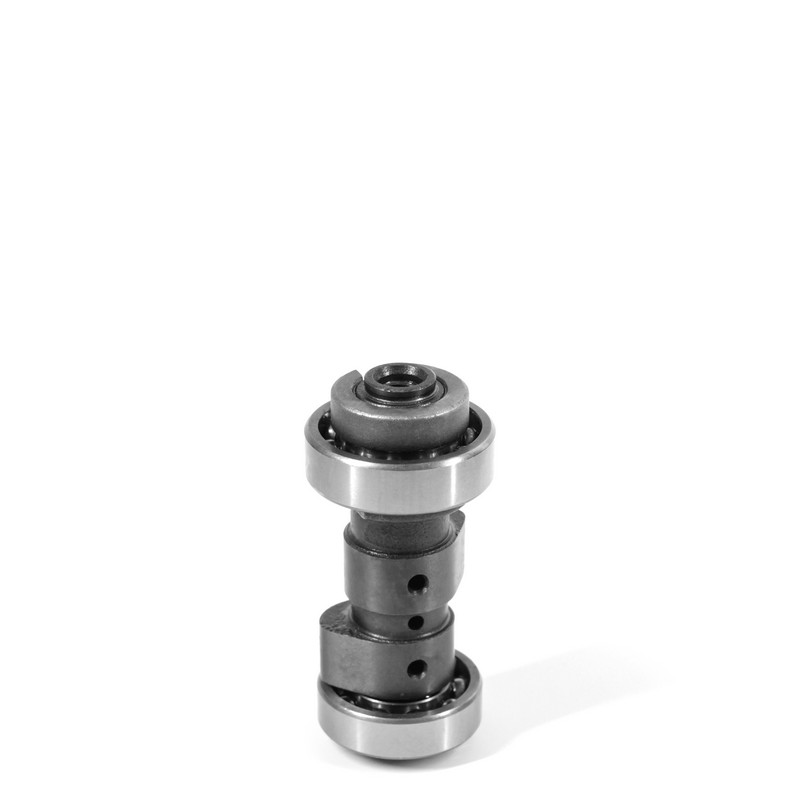
The longevity of a camshaft is fundamentally determined by its ability to resist abrasive and adhesive wear.
Pitting is a fatigue failure resulting from repeated stress cycles that exceed the material's endurance limit. The technical challenge for Preventing cam lobe pitting in high-performance motorcycle camshafts involves ensuring not only high surface hardness but also a suitable case depth—the thickness of the hardened layer—to effectively distribute stress and avoid micro-cracks that propagate to the surface.
The core material provides the necessary toughness and fatigue strength, while the surface treatment provides the required wear resistance.
The core heat treatment (such as tempering or quenching and tempering) dictates the internal microstructure and resilience against fracture. A properly executed Camshaft heat treatment process effect on fatigue life ensures the material core remains tough and ductile, preventing catastrophic failure while the surface remains hard and wear-resistant.
The choice between surface hardening techniques depends on the base material and the required performance profile.
Both techniques aim to create a hardened case. However, nitriding typically provides a shallower case depth (e.g., 0.3-0.5 mm) with very high surface hardness, while chill casting can result in a deeper case but may have structural inconsistencies at the transition zone.
| Treatment Method | Primary Material | Typical Surface Hardness (HRC) | Wear Resistance Quality |
|---|---|---|---|
| Nitriding | Alloy Steel | 58-65 | Excellent (High fatigue life, minimal distortion) |
| Chill Casting | Cast Iron | 55-62 | Good (Cost-effective, integral hardness) |
Meeting the precise Cam lobe surface hardness requirements for motorcycle engines is verified through stringent quality control at the manufacturing level.
Anhui KORBOR Machinery Co., Ltd. is one of the top camshaft manufacturers in the country, founded in 1999 and now located in Susong Economic Development Zone. With 25 years of dedicated innovation, camshaft production is our sole focus. We select high-performance alloys and employ strict heat treatment processes—including tempering, carburizing, and quenching—to significantly enhance the strength and hardness of every **YAMAHA Motorcycle Camshaft**, ensuring superior performance and compliance with the IATF16949:2016 standard. Our commitment to the "zero defect" concept and multi-level quality control, from blank casting to finished products, ensures that our high-precision mass-produced components meet the demanding Cam lobe surface hardness requirements for motorcycle engines and resist wear, effectively Preventing cam lobe pitting in high-performance motorcycle camshafts. KORBOR delivers reliable quality and professional solutions, serving as an ideal partner in the automotive and motorcycle engine camshaft field.

High surface hardness is critical to resist the extreme contact pressure and shear forces between the cam lobe and the valve follower, which prevents abrasive wear and fatigue failure like pitting.
Nitriding is a thermochemical process applied to steel that creates a wear-resistant case with high fatigue strength, while chill casting is a manufacturing technique used for cast iron to achieve a hard surface layer through rapid cooling.
The minimum surface hardness standard for highly stressed motorcycle camshafts typically ranges from HRC 55 to HRC 65, depending on the base material and specific application load.
The core heat treatment (e.g., tempering) optimizes the microstructure of the core material, increasing its toughness and fatigue endurance limit, thereby preventing catastrophic failure under cyclic stress.
Meeting these requirements involves selecting the correct high-performance alloy and applying a controlled surface treatment (like nitriding) to achieve the specified HRC value and adequate case depth, which is verified using Rockwell or Vickers hardness testing protocols.</HED
provide one-stop service from blank casting to finished product finishing, fundamentally control product stability, to ensure delivery.

 English
 中文简体
中文简体 русский
 Español



 闽公网安备35018102000203号