Article Directory
A four-cylinder DOHC passenger car engine opens each of its sixteen valves roughly forty times per second at 6,000 rpm, yet the camshaft that commands those events is one of the least understood parts in the valvetrain. In aftermarket supply and production programs alike, camshaft choice determines idle quality, fuel economy, emissions behavior and where peak torque lands. Anhui KORBOR Machinery Co., Ltd. has manufactured camshafts continuously since 1999 and catalogues more than 800 passenger car camshaft models.
A camshaft converts crankshaft rotation into precisely timed valve opening and closing, and it does so at exactly half engine speed in every four-stroke passenger car engine.
The crankshaft drives the camshaft through a timing chain, belt, or gear set at a 2:1 ratio. Each lobe on the shaft pushes a follower, bucket, or rocker arm to lift a valve off its seat. The shape of the lobe, together with its angular position on the shaft, defines three numbers that matter in every application: lift, duration, and lobe centerline. Change any one of these and the torque curve moves to a different rpm range.
The number, position, and function of camshafts in a passenger car are fixed by the engine architecture, and each layout creates a different set of application requirements for the part.
Single overhead camshaft (SOHC) engines use one camshaft per cylinder bank to operate both intake and exhaust valves. Dual overhead camshaft (DOHC) engines use a separate camshaft for each function, which permits independent valve timing and higher-rpm operation. Older cam-in-block (OHV) designs place a single camshaft inside the cylinder block and drive the valves through pushrods and rocker arms. Each family has distinct lobe profile, journal, and lubrication requirements.
| Engine architecture | Camshafts per bank | Valve actuation | Typical passenger car use |
| SOHC | 1 | Direct actuation or rocker arms | Entry-level and mid-size inline engines |
| DOHC | 2 | Bucket or roller followers | Most modern gasoline passenger cars |
| Cam-in-block (OHV) | 1, in the block | Pushrods and rocker arms | Legacy small-displacement and V8 platforms |
For a supplier, the consequence is straightforward: model coverage must extend across all three architectures. KORBOR lists camshafts for European, Asian, and North American passenger car platforms, with European passenger car camshaft coverage spanning the compact and mid-size engine families most common in that region.
Passenger car camshafts operate under high cyclic contact stress against their followers, so material grade and heat treatment determine service life before any other design factor.
Three material families dominate passenger car production. Chilled cast iron forms a hard, wear-resistant lobe surface directly during casting and is the most cost-efficient choice at high volume. Nodular, or ductile, cast iron adds toughness and impact resistance. Alloy steel, normally carburized and then hardened, is specified where contact stress is highest, such as high-output and turbocharged engines.
Heat treatment controls final lobe hardness. Carburizing adds a carbon-rich case to alloy steel. Induction and flame hardening do the same for iron, and nitriding adds nitrogen to produce a thin, extremely hard surface layer. Tempering after quenching relieves internal stress. These cycles are where most batch quality problems begin, and where they are prevented.
Performance camshaft selection in a passenger car is a trade between lobe profile and the engine's displacement, compression ratio, and intended rpm band, so the profile must be chosen for the operating range before anything else.
Three application classes cover most passenger car work: OEM-equivalent replacement, mild street performance, and turbocharged builds. OEM-equivalent profiles hold factory idle quality, emissions calibration, and low-end torque. Mild street profiles add duration and lift without moving the power band far enough to hurt driveability. Turbocharged builds concentrate on overlap control and exhaust-side timing to reduce charge reversion.
Forced-induction engines make the application more specific. In a VW turbo engine, intake and exhaust profiles behave differently under boost, so the camshaft must be selected with the turbocharger in mind. KORBOR produces VW turbo engine camshaft replacements that preserve factory timing references while allowing controlled profile upgrades.
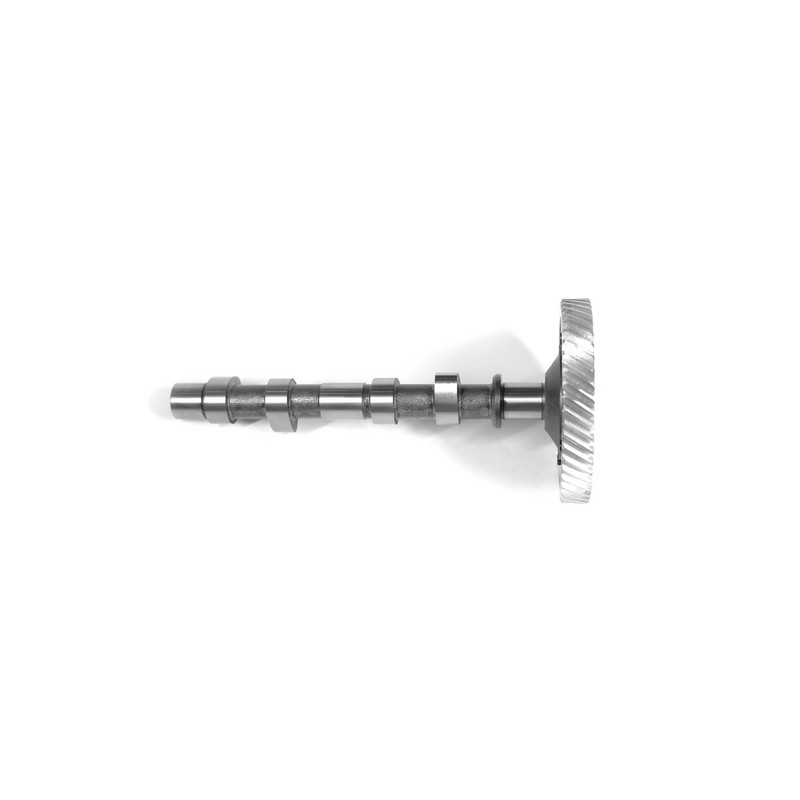 Wholesale Car camshaft-VW-KB-624 Suppliers, Manufacturers, CompanyANHUI KORBOR MACHINERY CO., LTD. Is China Wholesale VW-Car camshaft-KB-624 Suppliers, Manufacturers And Company, We Offer VW-Car camshaft...View Product →
Sourcing passenger car camshafts in volume comes down to model coverage, dimensional consistency, process control, and delivery discipline, and each one is verifiable before a purchase order is placed.
A passenger car camshaft must match the original base circle, journal diameters, keyway position, thrust face, and lobe profile within tight tolerances. Lobe profiles are normally verified with a cam measuring machine. Runout and straightness are checked between centers, and hardness is tested on every production batch.
One-stop suppliers shorten this loop. KORBOR produces from blank casting to finished part under the same roof, which keeps dimensional and metallurgical data consistent from melt to machine. That matters when a single purchase order covers dozens of part numbers, and it is the result of 25 years of camshaft-only manufacturing history.
Model coverage is the other half of the equation. A supplier that can quote a Ford passenger car camshaft replacement and a Toyota passenger car camshaft for Asian platforms from the same process window simplifies sourcing and cuts qualification time.
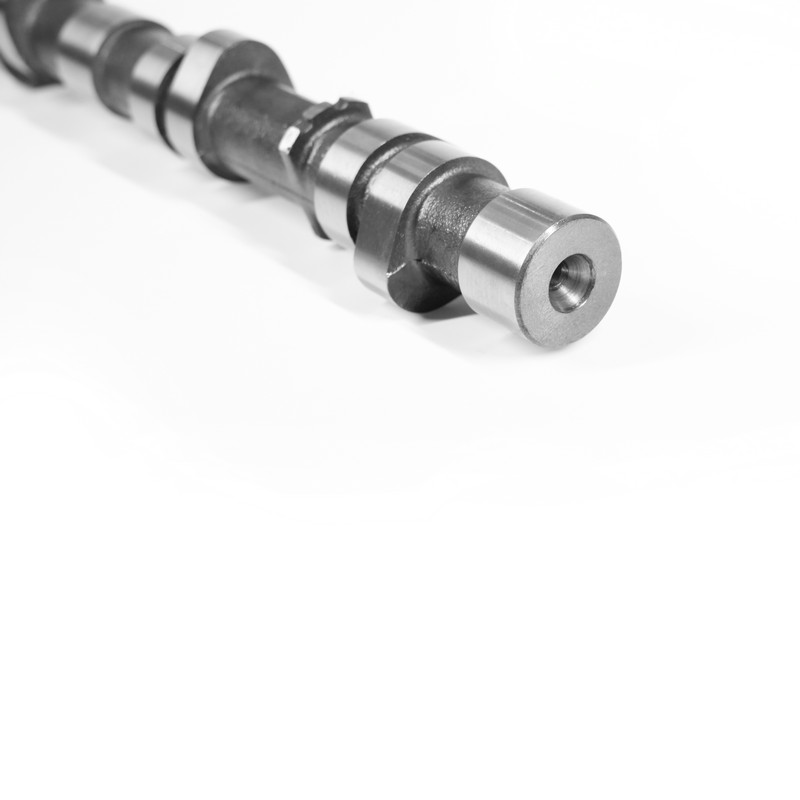 Wholesale Car camshaft-TOYOTA-KB-014 Suppliers, Manufacturers, CompanyANHUI KORBOR MACHINERY CO., LTD. Is China Wholesale TOYOTA-Car camshaft-KB-014 Suppliers, Manufacturers And Company, We Offer TOYOTA-Car ...View Product →
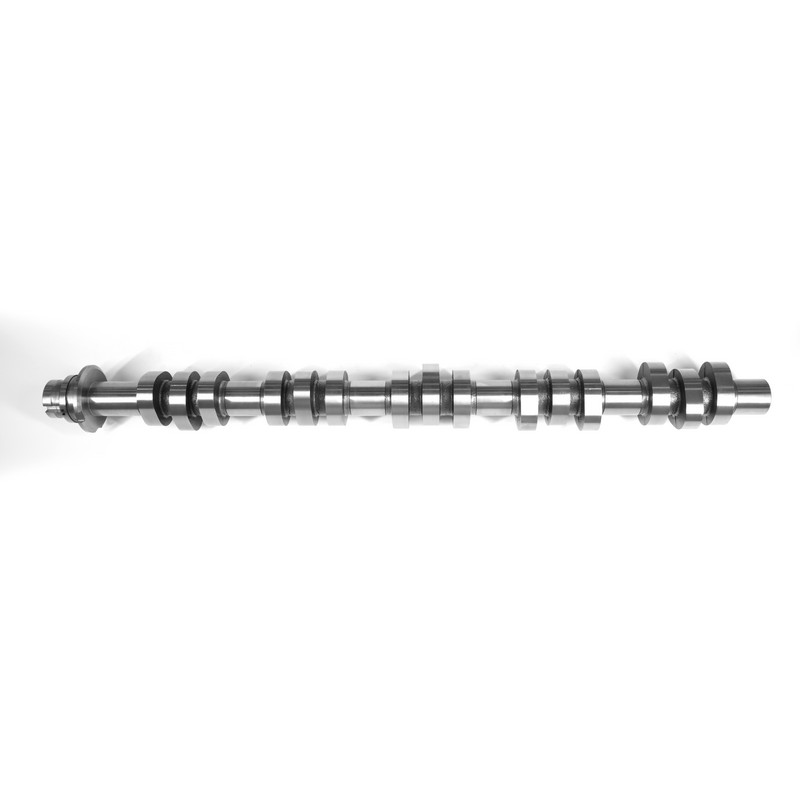 Wholesale Car camshaft-FORD-5C3Z6250BA Suppliers, Manufacturers, CompanyANHUI KORBOR MACHINERY CO., LTD. Is China Wholesale FORD-Car camshaft-5C3Z6250BA Suppliers, Manufacturers And Company, We Offer FORD-Car ...View Product →
A single-overhead-cam inline engine uses one camshaft. A DOHC inline engine uses two. In V engines the count multiplies by cylinder bank, so a DOHC V6 uses four camshafts and a DOHC V8 also uses four.
SOHC keeps the valvetrain compact with one camshaft operating both valves per bank. DOHC gives independent intake and exhaust timing, lower valvetrain inertia, and a higher usable rpm range, at a higher manufacturing cost.
Chilled cast iron provides the best cost-to-wear balance for high-volume passenger car applications. Nodular iron is preferred when impact loads matter, and carburized alloy steel is specified for high-output or turbocharged engines.
Yes, with checks. Higher lift and longer duration raise valve-spring and piston-clearance demands. Engines with variable valve timing need a profile that respects the phase-control range, and the engine control unit usually requires recalibration.
provide one-stop service from blank casting to finished product finishing, fundamentally control product stability, to ensure delivery.

 English
 中文简体
中文简体 русский
 Español



 闽公网安备35018102000203号