Article Directory
An engine builder who swaps a stock camshaft for a performance grind with 0.450 in. intake lift and 280 degrees of duration will see the power band move upward by 1,500 to 2,500 RPM. The same change will soften idle vacuum from roughly 18 in. Hg to 11 in. Hg and make the idle noticeably rougher. These are not incidental side effects; they are direct consequences of camshaft profile geometry. Understanding this geometry is the first step to specifying the right camshaft for any engine.
A camshaft profile controls how far, how long, and when each valve opens. It is the exact geometric shape of every lobe that determines the valve lift curve, the duration of valve opening, and the timing relationship between intake and exhaust events.
Camshaft profile: the precise geometry of a cam lobe, including base circle radius, ramp length, flank shape, nose radius, and total lift. Together these determine valve lift, duration, overlap, and the exact moments when the intake and exhaust valves open and close.
The profile is encoded in the lobe from base circle to nose. Changes as small as 0.005 in. in lift or 4 degrees in duration can shift the torque peak by several hundred RPM. This is why engineering teams invest so much time in profile development.
Three measurements define a camshaft profile in practical terms: valve lift, duration, and lobe separation angle. Each one plays a different role in shaping engine output.
Valve lift is how far the valve opens, measured in millimeters or inches. More lift allows more air and fuel into the cylinder and more exhaust out. The practical limits are valve spring capacity and piston-to-valve clearance. Increasing lift from 10 mm to 11.5 mm on a 2.0 L engine can raise peak airflow by 6 to 10 percent at high RPM, but it requires stronger springs and hardened retainers.
Duration is how long the valve stays open, measured in degrees of crankshaft rotation. Longer duration moves the power band to higher RPM because the intake and exhaust events need more time at high piston speeds. But it also creates more valve overlap, which allows unburned mixture to escape at low RPM, hurting idle quality and low-speed torque.
Lobe separation angle is the angular distance between the intake and exhaust lobe centerlines. A narrower LSA of 106 to 108 degrees increases overlap and produces a stronger reversion wave that helps scavenging at high RPM. A wider LSA of 112 to 114 degrees reduces overlap, creating a smoother idle and a flatter torque curve.
Rule of thumb: 4 degrees of additional duration moves the torque peak about 200 RPM; 0.020 in. of lift adds roughly 3 to 4 percent more airflow at high RPM.
The relationship between profile and output follows predictable patterns. Increasing duration and lift moves the torque curve to the right. Widening LSA broadens the power band but reduces peak output. The choice depends on where the operator wants the engine to work.
| Parameter | Stock | Street Performance | Race |
| Intake duration | 240 deg | 268 deg | 290 deg |
| Intake lift | 0.350 in. | 0.440 in. | 0.500 in. |
| Lobe separation angle | 114 deg | 110 deg | 106 deg |
| Torque peak | 3,400 RPM | 4,300 RPM | 5,600 RPM |
| Idle vacuum | 18 in. Hg | 14 in. Hg | 10 in. Hg |
Overlap is the hidden variable. At low RPM, overlap lets exhaust gas dilute the fresh intake charge, which reduces combustion stability. At high RPM, the same overlap creates a pressure wave that pulls fresh mixture into the cylinder. This is why a race camshaft idles poorly but makes huge power above 5,000 RPM.
Practical example: On a 2.0 L four-cylinder, changing from a stock 240-degree profile to a 268-degree profile with 0.440 in. lift raises peak horsepower from 140 to 165, but idle vacuum drops from 18 to 13 in. Hg. The engine becomes easier to stall in traffic and needs a retune of the fuel table.
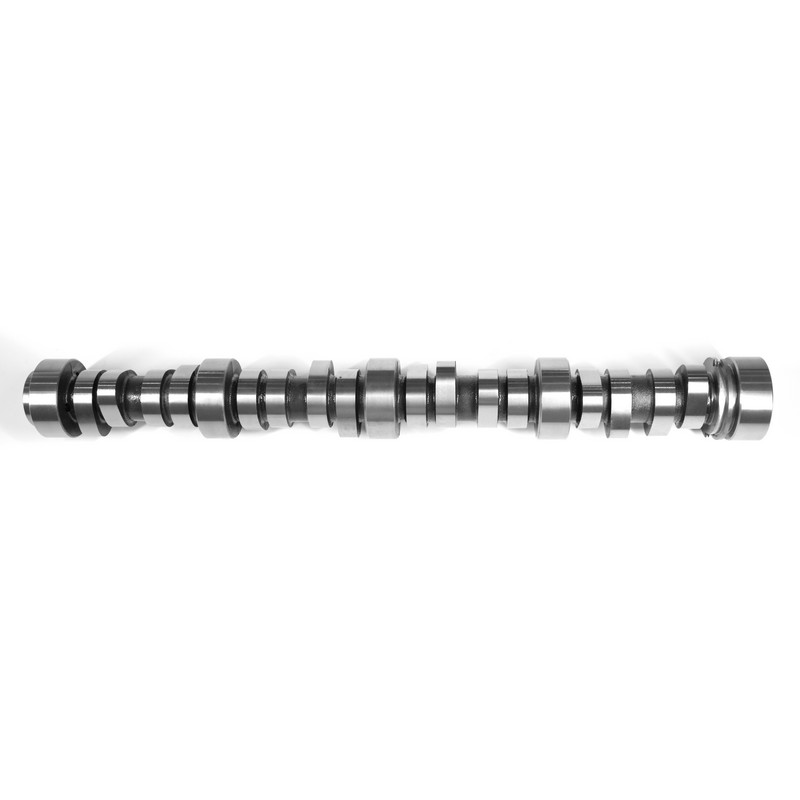 V8 Vortec 5.3L Camshaft for Chevy and GMC TrucksDesigned for V8 5.3L Vortec engines in Chevy and GMC trucks, this camshaft suits daily-driven applications with moderate duration and stable idle, enhancing mid-range power without sacrificing drivability.View Product →
For a daily-driven street engine, the best profile has moderate duration of 260 to 268 degrees, lift of 0.400 to 0.440 in., and a lobe separation angle near 112 degrees. This keeps idle stable, maintains vacuum-assisted accessories, and still improves mid-range power.
For a track engine that lives above 4,500 RPM, choose a longer duration of 280 degrees or more and a narrower LSA of 106 to 108 degrees. This trades low-speed drivability for a strong top-end pull. The tradeoff is real: a 290-degree profile will idle poorly and can make tuning at low speed very difficult.
Custom profiles give engine builders unusual control. KORBOR offers custom camshaft profiles developed around specific engine platforms and performance targets, instead of relying on off-the-shelf grind families.
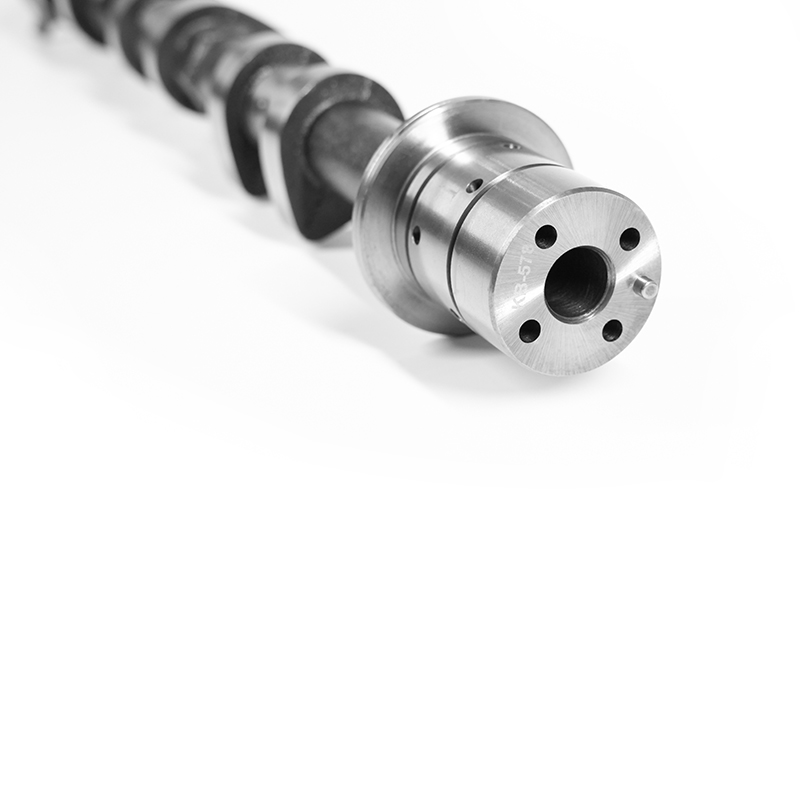 Ford 3.5L V6 Left Exhaust Camshaft ReplacementThis precision-engineered camshaft is a direct replacement for Ford 3.5L V6 left exhaust applications, ensuring accurate valve timing and reliable performance for engine service professionals.View Product →
The most sophisticated profile design is worthless if the lobe cannot be ground to specification. Finished automotive camshafts are typically held to profile accuracy within 0.0005 in., with flank surface finish of Ra 0.2 to 0.4 micrometers.
Material selection also matters. Chilled cast iron provides wear resistance and is common in mass-produced OEM camshafts, while billet steel is used for performance and racing applications because it can be machined to tighter tolerances and handles higher valve spring loads.
At Anhui KORBOR Machinery Co., Ltd., camshaft profiles are manufactured and checked under the IATF16949:2016 quality standard, with a zero-defect production philosophy. The company's quality management process covers each step from blank casting to finished part, which is especially important when a profile has aggressive lift and duration values. KORBOR produces more than 800 automotive camshaft models and 600 motorcycle camshaft models, each held to the same tolerance discipline.
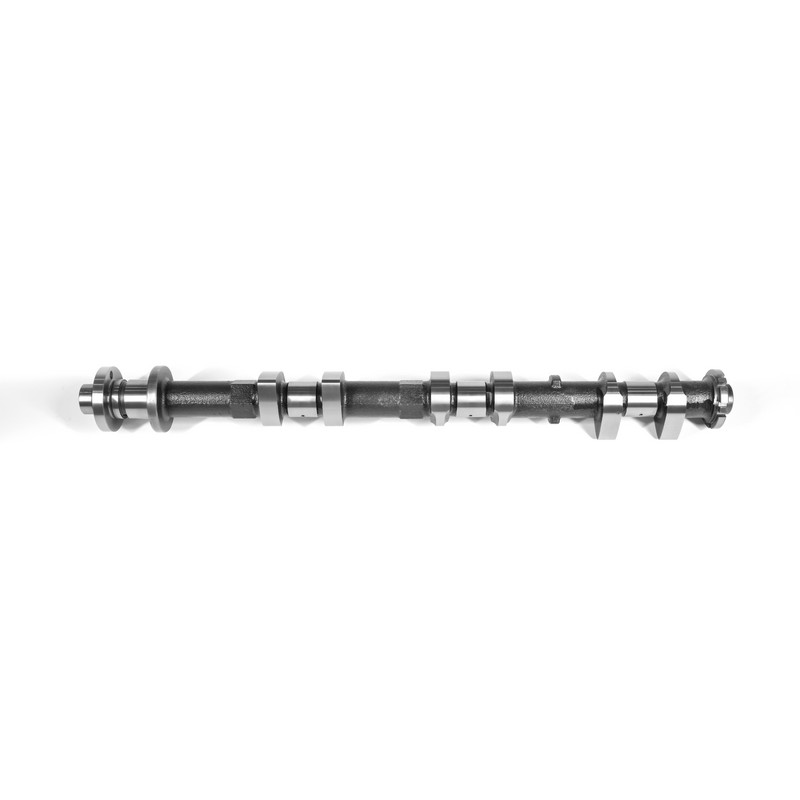 KORBOR High-Quality Automotive Camshaft KB-400As part of a broad and quality-assured line, KORBOR's KB-400 exemplifies IATF16949-standard production with consistent tolerances, making it a dependable choice when exact profile and durability matter.View Product →
For a street-driven engine, choose a profile with 260 to 268 degrees of intake duration, 0.400 to 0.440 in. of lift, and a lobe separation angle of 110 to 112 degrees. This configuration retains stable idle vacuum while improving mid-range torque.
A profile with increased duration and overlap will reduce fuel economy at low RPM because more unburned mixture escapes during overlap. A profile with moderate duration and wider LSA keeps combustion efficient at cruising speeds, which is why many OEMs designed for fuel economy use LSA values of 114 degrees or wider.
Not always. If the new profile has significantly more lift or a faster opening ramp than stock, the existing valve springs may not control the valve train at high RPM. This can cause valve float, which damages the profile and reduces power. Valve spring upgrades are required in most performance camshaft installations.
A camshaft spec sheet lists lift, duration at 0.050 in. of lift, and lobe separation angle. Duration is the most common way to compare camshafts between manufacturers because it eliminates the effects of different ramp designs. The intake centerline tells you whether the profile is intended for mid-range or top-end power.
provide one-stop service from blank casting to finished product finishing, fundamentally control product stability, to ensure delivery.

 English
 中文简体
 русский
 Español




 闽公网安备35018102000203号
