Article Directory
When the casting comes from one foundry, heat treatment from a second plant, and final grinding from a third, the delivered camshaft is the sum of three process windows, three measurement systems, and three readings of the same drawing. One-stop camshaft manufacturing removes that arithmetic. Everything between molten alloy and a boxed, inspected part stays inside one facility, under one quality certificate, measured against one process capability record.
One-stop camshaft manufacturing means blank casting, heat treatment, precision grinding and final metrology for a given part number all sit inside a single facility and a single IATF 16949:2016 quality system, so one capability record covers the whole part instead of a fraction of it.
Anhui KORBOR Machinery Co., Ltd., which trades under the KORBOR brand, is built on that structure. Its camshaft work starts in 1999, and the current base is a 28,000 sq m site in the Susong Economic Development Zone in Anqing, Anhui, with 22,000 sq m of plant, registered capital of RMB 11 million and total investment above RMB 100 million. The catalogue carries more than 800 automotive camshaft part numbers, produced in one plant rather than assembled from purchased sub-components.
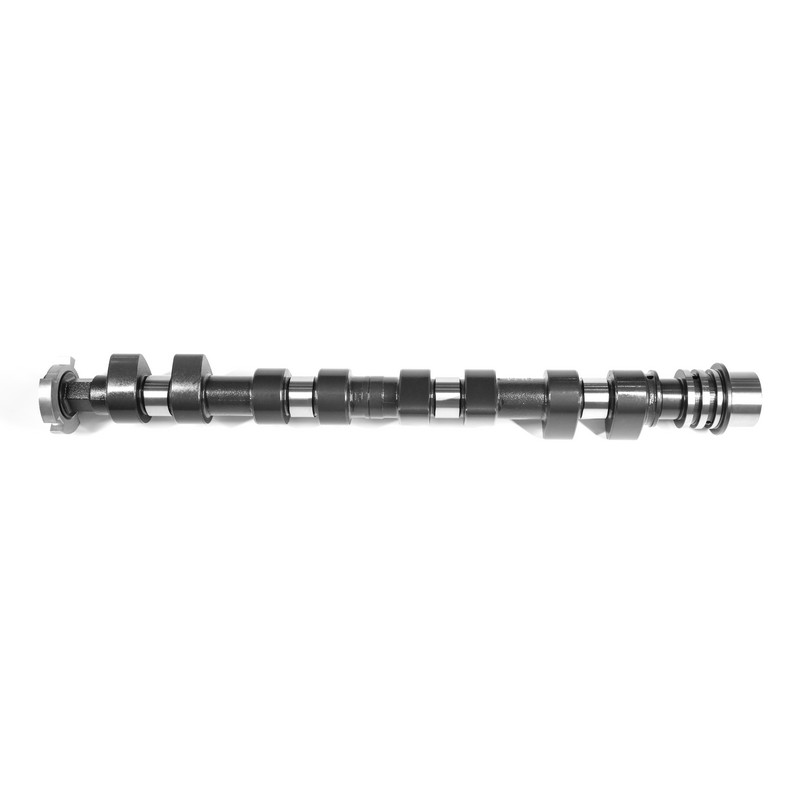 Automobile Camshafts by Brand and Custom Blank ProfilesKORBOR’s automobile camshaft category lists over 800 OEM/ODM replacement and custom blank models by brand, with drawing-or-sample development for unlisted applications.View Product →
Every time a camshaft crosses a company boundary, a new measurement system, a new heat-treatment recipe and a new acceptance decision enter the process, and none of them is visible to the buyer until parts fail.
The failure is rarely a wrong part. It is a drifted part. A foundry changes its charge mix, a heat treater adjusts a quench, and a grinding shop re-clamps a batch on a fixture that sits 0.01 mm off the datum the drawing assumes. Each change is small, and each one looks acceptable on its own.
On a 500-piece order, one hardness excursion can consume the entire margin of the batch before the parts reach a dock. Consolidation is an economic argument before it becomes a technical one.
Six controlled stages sit between scrap alloy and a shipped camshaft, and each stage leaves a number the next stage depends on.
Stages three and four are where split chains lose the most. Carburizing decides hardness; grinding decides geometry. When they happen in different companies, an out-of-spec case depth is usually discovered after grinding has already been paid for.
IATF 16949:2016 asks for process capability data rather than final-part inspection alone, so a one-stop camshaft plant can report capability separately for casting, heat treatment and grinding, then combine them into one delivered-part figure.
KORBOR runs production to IATF 16949:2016 under a zero-defect programme with layered controls at every stage, and it audits its own supply partners against the same environmental and labour requirements. Buyers can review the full quality management approach before a first order is placed.
| Stage | What is controlled | Why it matters across batches |
| Alloy and melt | Grade chemistry and heat-number traceability | A different heat number changes machinability and hardenability |
| Hardness after hardening | Lobe hardness tested to ISO 6508, typically 55 to 62 HRC for carburized steel | Low hardness shortens wear life; high hardness raises pitting risk |
| Case depth | Effective case depth after carburizing, typically 0.8 to 1.2 mm | Too shallow causes spalling; too deep makes the lobe brittle |
| Journal geometry | Diameter, roundness and runout, normally under 0.02 mm | Controls oil film, noise and bearing life |
| Lobe surface finish | Roughness held in a band, typically 0.4 to 0.8 micron Ra | Determines break-in wear against the follower |
| Cam profile and lift | Lift held within 0.05 mm of nominal | Sets valve timing, idle quality and emissions compliance |
KORBOR delivers more than 2.3 million camshaft sets a year from a 22,000 sq m plant, covering over 1,400 part numbers across automotive and motorcycle engines.
Capacity is what makes the one-stop model work at programme level. A plant that casts, hardens and grinds its own blanks schedules all three stages against one delivery date, which is why production capacity planning becomes a shipping commitment instead of a chain of promises.
Camshaft catalogue coverage at KORBOR (part numbers)
The motorcycle side shows how far a shared process platform stretches. More than 600 motorcycle camshaft part numbers run through the same casting, heat-treatment and grinding controls as the automotive range, which keeps a small-volume part number economically viable instead of pushing it onto a separate line.
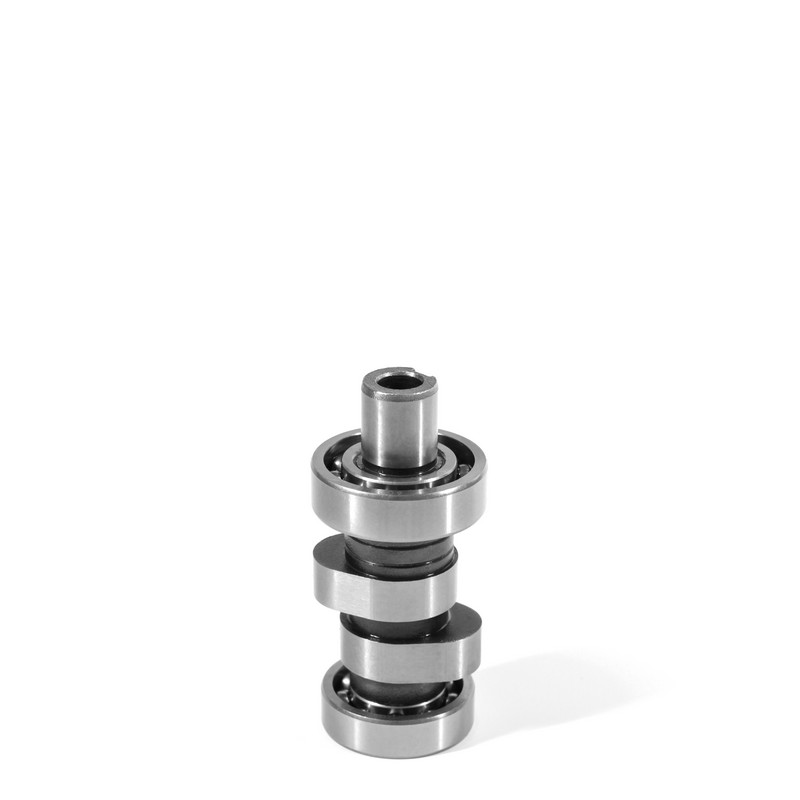 Motorcycle Camshafts for OEM Replacement and Custom ProfilesThe motorcycle camshaft category covers 600+ models across Honda, Yamaha, Suzuki and other brands, with OEM replacement or custom profiles and IATF16949 manufacturing.View Product →
Ask for the IATF 16949:2016 certificate with its declared scope, a PPAP submission at Level 3 under the AIAG PPAP 4th edition, material certificates carrying the heat number, hardness reports measured to ISO 6508, and a dimensional layout on the datum the drawing specifies. A certificate of conformity alone does not demonstrate capability.
It usually removes cost instead of adding it. Casting, hardening and grinding inside one facility eliminate the freight and re-inspection that sit between three suppliers, and they move scrap risk upstream of shipment, where a 500-piece lot can still be reworked before it reaches a customer line.
KORBOR's catalogue carries more than 800 automotive camshaft part numbers and more than 600 motorcycle part numbers, over 1,400 in total, delivered as more than 2.3 million sets a year. Breadth at that scale comes from a shared process platform, not from a separate line for every part number.
Traceability decides the answer. With a heat number recorded at casting, a hardness reading logged after hardening, and a grinding record tied to the same datum, a one-stop manufacturer can bound a suspect population to a batch instead of an entire programme.
provide one-stop service from blank casting to finished product finishing, fundamentally control product stability, to ensure delivery.

 English
 中文简体
 русский
 Español




 闽公网安备35018102000203号
